Patient Hazards and Device Malfunctions: ECI Device Final Revision Report
This document outlines various patient hazards associated with the ECI device, finalizing the revisions as of April 17, 2006. Key issues include interference with medical procedures, distractions from loud music and LED lights, and the risk of physical harm through tight straps and electrical faults. Specific cases are examined in detail, highlighting incidents of allergic reactions, seizures, and general device malfunction. Clinicians report concerns regarding the device's function and safety, urging caution during its operation to mitigate potential risks to patients and healthcare providers.

Patient Hazards and Device Malfunctions: ECI Device Final Revision Report
E N D
Presentation Transcript
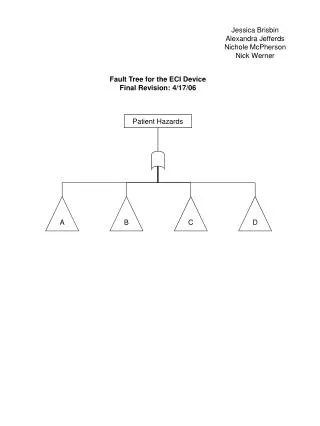
Jessica Brisbin Alexandra Jefferds Nichole McPherson Nick Werner Fault Tree for the ECI Device Final Revision: 4/17/06 Patient Hazards A B C D
A Jessica Brisbin Alexandra Jefferds Nichole McPherson Nick Werner Device interferes with medical procedure. Clinician finds device distracting. Vibration of arm with device conducts to arm of injection. Clinician thinks music is too loud. Clinician is tired of hearing the same song over and over. LEDs distract clinician. Patient overreacts to device. Patient thinks music is too loud. Patient is hyper-sensitive to noise.
B Jessica Brisbin Alexandra Jefferds Nichole McPherson Nick Werner Device is a direct hazard to patient. Arm band disrupts blood flow. Electrical interference with other devices. Band is applied too tightly. Speakers emit sound waves. Components emit EM radiation. Device causes a seizure in patient. Device causes an allergic reaction in patient. Patient has a seizure disorder. Patient has an allergy. Flashing of LEDs. Arm band is not hypo-allergenic.
C Jessica Brisbin Alexandra Jefferds Nichole McPherson Nick Werner Device won’t stay on the limb. Patient’s arm is too small for the strap. Patient’s arm is too large for the strap. Strap doesn’t fit around the arm. Strap cannot be replaced with a larger one. Strap doesn’t fit around the arm. Strap cannot be replaced with a smaller one. Strap connection comes apart. Strap breaks. Strap material is inadequately strong. Strap is subjected to extreme loads. Velcro is dirty. Velcro is inadequately adhesive.
D Jessica Brisbin Alexandra Jefferds Nichole McPherson Nick Werner Device can’t be operated (safely). Switch doesn’t work. Device stops working. Electrical connection breaks. Device is submerged in liquid. Switch is difficult to operate. Switch breaks. Strong connection was not made to begin with. Device is dropped. Switch is stiff. Switch is too small. Device electrocutes clinician or patient Case cracks. Device is submerged in liquid Electrical component breaks.