
Watch Your Back! Amphibious Wireless Vehicle Presentation
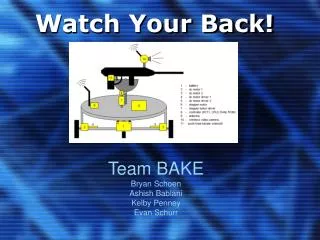
The "Watch Your Back!" project presents a wirelessly controlled amphibious vehicle designed to perform various human tasks while enhancing safety. Equipped with a camera and paintball gun, it can transport items, analyze hazardous situations, and execute necessary actions remotely, eliminating threats to human lives. Key features include 360-degree horizontal movement, integrated sensors, and real-time data transmission for effective monitoring. This vehicle is suitable for security, recreational use, and more. Join the team for an overview of design, implementation, timeline, and risks.

Watch Your Back! Amphibious Wireless Vehicle Presentation
E N D
Presentation Transcript
Watch Your Back! Team BAKE Bryan Schoen Ashish Bablani Kelby Penney Evan Schurr
Overview of Presentation 1. Project Description 2. Project Design 3. Proposed Additional Features 4. Timeline / Labor Distribution 5. Cost / Risk
Introduction and Purpose • Watch Your Back! is a wirelessly controlled amphibious vehicle armed with a camera with abilities to perform a wide variety of human tasks • Ability to transport items from one room to another • Can be used to enter hazardous situations, analyze the situation and risks, and perform necessary actions • Eliminates threats to human lives in a battlefield when equipped with a gun • Home/Business Security • Recreational
Objectives • Eliminate threats to human life • Will equip the amphibious vehicle with a paintball gun and camera • Will be able to control from a remote location • Have ability to maneuver and fire from remote location • View all data and react in real time
Description • Wireless amphibious vehicle equipped with a camera and paintball gun • Sensors may include: motion, video, audio and light • Vehicle can be controlled by 802.11B communication • The data will be transferred back wirelessly to a computer with a controller (keyboard or PS2 controller) • Data can be viewed and controlled in real time by a user interface
Mechanical Aspects • Pre-assembled Metal Mobile Platform • Two 8 Inch Wheels • Two 2 Inch Stabilizing Wheels • Vertical motion Gear
DC Motors/Gun Trigger • Two 9FGHD Ferrite Series ServoDisc Motors • 0.9 Deg/Step Stepper Motor • Push Type Tubular Solenoid
PWM Controlled Motor Drives • Two DC/DC Converters with PWM Input • Input Voltage 12V • Output Voltage 0-15 V • Inverter Switch for Reverse Control
M68HC11K1Microcontroller • 4 MHz Clock • 16-bit addressing • 84-pin PLCC Package • Four 8-bit pulse-width modulation (PWM) outputs • Enhanced asynchronous serial communications interface (SCI) • Dual-function I/O lines — Any pins used for the microcontroller’s peripheral functions can be configured as general-purpose I/O lines M68HC11K 84-Pin PLCCC
Memory • RAM • 64 Mb SDRAM • ROM • 64 Mb • 44 Pin - CPLD • Used to store data
Wireless, Camera & Controller • 802.11g wireless control • VGA (640x480) quality wireless camera with integrated audio • Sony Playstation controller for horizontal/vertical movement and trigger controls
Mandatory/Extra Features Mandatory Features • 360 degree horizontal movement • Vertical movement of gun • Trigger control • Integrated wireless control & video Extra Features • Valentine’s Day Massacre (VDM) button • Audio output • Various sensors (wall, drop-off, etc.)
Possible Problems & Risks • TIMING! • Recoil of gun & stability • Weight/friction & current limiting the DC motors • Smooth rotational movement of the motors • Exceeding the motor specifications
Hardware Implementation Wireless Web-Cam 44 pin CPLD Control signal Motorola 68HC11K1 Micro-Processor Serial RS-232 Paintball gun - trigger Wireless transmission Driver for trigger Rom DC Motor Drivers Ram 1 Stepper Motor Computer 2 DC Servo Disc Motors
Work Distribution Brian Ashish Kelby / Evan • Documentation • Documentation • Documentation • Setting up the web cam • Programming the HC11K1 to control the DC motor drivers • Designing and implementing DC/DC motor drivers • Programming the HC11K1 to control the DC motor drivers • Designing and implementing stepper motor drivers • Designing and implementing trigger driver for paintball gun • Designing and implementing trigger driver for paintball gun • Designing a gear system for the stepper motor
References • "Freescale Semiconductor." M68HC11K Family Technical Data HCMOS M68HC11K Family. 2001. Motorola, Inc.. 12 Sep 2006 <http://www.freescale.com/files/microcontrollers/doc/data_sheet/M68HC11K.pdf>.