Download

1 / 6
60 likes | 188 Vues
This resource focuses on the principles of optimization and differentials in calculus, exploring how to determine maximum and minimum values of functions. It outlines key guidelines for solving optimization problems, including identifying variables, formulating primary equations, and using derivatives to find solutions. Additionally, the section on differentials introduces fundamental formulas for calculating changes in functions and provides insights into error propagation through practical examples. Supplementary online resources are also shared for deeper learning.

E N D
Optimization and Differentials(Sections 3.7 and 3.9) By Brandan Jeter, Zach Young, and Daniel Cotton
Optimization • Optimization is the process of using calculus to determine the maximum or minimum value of a given function. • For example, you’re given the surface area of a cube, and you want to find the maximum volume of that cube.
Optimization Guidelines • 1. Identify all given quantities and quantities to be determined. • 2. Write a primary equation for the quantity that is to be maximized or minimized. • 3. Reduce the primary equation to one having a single independent variable. This may involve using secondary equations. • 4. Determine the desired maximum or minimum by finding the derivative.
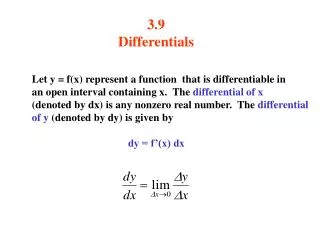
Differentials • dy=f’(x)dx • d(cu)=c du • d(u±v)=du±dv • D(uv)=udv+vdu • D(u/v)=(vdu-udv)/v2
Error Propagation • For example, the radius of a ball is .7 inches with an error within .01 inches. Estimate the propagated error of the volume of the ball. • V=(4/3)r3 • dV=4 r2dr • =4 (0.7)(±0.01) • =±0.0616 cubic inches
Additional Resources • Optimization • http://tutorial.math.lamar.edu/Classes/CalcI/Optimization.aspx • http://www.qcalculus.com/cal08.htm • Differentials • http://tutorial.math.lamar.edu/Classes/CalcI/Differentials.aspx • http://www.cliffsnotes.com/study_guide/Differentials.topicArticleId-39909,articleId-39898.html