Differentials (3.9)
This guide explains the concept of differentials in calculus, focusing on the derivative of a function and its application in finding the equation of tangent lines. It covers the definitions of dy and dx, and how to use differentials for linear approximations of functions. The material includes differentiation rules in differential form, with examples for practicing these concepts. Key exercises illustrate how to evaluate and compare differentials effectively, enhancing your understanding of how to approximate function values accurately.


Differentials (3.9)
E N D
Presentation Transcript
Differentials (3.9) • December 14th, 2012
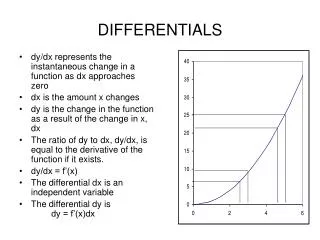
I. Differentials *The process of using the derivative of a function y with respect to x, or , to find the equation of the tangent line at a given point on the function is to find a linear approximation of the function at that point. dy is the differential of y and dx= is the differential of x.
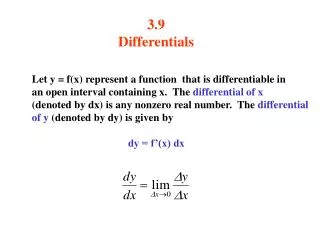
Def. of Differentials: Let y=f(x) be a function that is differentiable on an open interval containing x. The differential of x, or dx, is any nonzero real number. The differential of y, or dy, is . *This results from solving the identity .
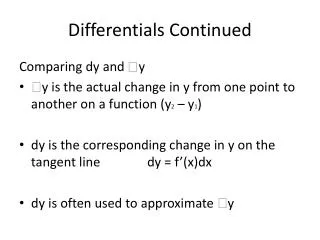
*dy is an approximation of , where for a point (c, f(c)) on the function.
Ex. 1: Given the function , evaluate and compare and dy when x = 0 and = dx= -0.1.
You Try: Given the function y=2x+1, evaluate and compare and dy when x = 2 and = dx = 0.01.
II. calculating differentials *If u and v are both differentiable functions of x, then their differentials are du=u’dx and dv=v’dx. Thus, all the differentiation rules can be written in differential form.
Differential Formulas: 1. Constant Multiple: 2. Sum or Difference: 3. Product: 4. Quotient:
Ex. 2: Find the differential dy of each function. a. b. c. d.
III. Using differentials to approximate function values *To approximate a function value for the function y=f(x), use .