Understanding Quadratic Functions: Notation, Types, and Characteristics
260 likes | 369 Vues
This comprehensive guide covers the fundamentals of quadratic functions, particularly focusing on their notation and types. It explains number line representations, set and interval notations, and provides insight into solid and open circles. Explore examples that illustrate the use of these notations, including set descriptions and interval representations for various cases. Understand domain and range calculations, and learn the process of completing the square for quadratic equations. Ideal for students seeking to master quadratic functions in mathematics.


Understanding Quadratic Functions: Notation, Types, and Characteristics
E N D
Presentation Transcript
Quadratic Functions By: Rebekah, Tara, Sam & Mel
-3 5 Three Types of Quadratic Functions • Number Line • Set Notation { x | -3 ≤ x < 5} • Interval Notation [-3, 5)
3 9 Number Line • If the number line has a solid circle then the that means that the number is included • If the number line has an open circle then the number is not included
Set Notation { x | -6 < x ≤ 8} • “x such that -6 is less than x, which is less than or equal to 8” • < less than • ≤ less than or equal to
Interval Notation [-8, 5) • Square bracket means including: [ ] • Round bracket means not including: ( )
-3 9 Example: Use set and internal notation to describe the following • The first circle is solid so the sign after -3 is ≤ • The second circle is hollow so the sign before 9 is < Set: {x | -3 ≤ x < 9} • The first circle is solid so the bracket is a square one • The second circle is hollow so the bracket is a circular one Interval: [-3, 9)
-5 Example: Use set and internal notation to describe the following Set: {x | -5 ≤ x } • The first circle is solid so the sign after -3 is ≤ • But there isn’t a second number so it ends at X • The first circle is solid so the bracket is a square one • These isn’t a second number, and because the arrow goes on forever there is an ∞ symbol with a round bracket Interval: [-5, ∞)
8 Example: Use set and internal notation to describe the following • The first number is ∞ and the second is 8, so the ∞ is represented by X • The circle is empty so a < sign is used Set: {x | x < 8 } • The first number ∞ • The second number is 8 and it is an empty circle so the bracket is round Interval: (-∞, 8)
Example: Use set and internal notation to describe the following Set: {x | x Є R} • There are no numbers on the line so it is an element of all reals Interval: (-∞, ∞) • The first number -∞ • The second number is ∞ • This line includes every positive and negative number
-2 0 10 Example: Use set and internal notation to describe the following Set: {x | -2 ≤ x ≤ 0 or 10 < x} • The first circle is solid so the sign after -2 is ≤, and the second number is 0 • OR 10 < x because the second circle is an open circle
-2 0 10 Example: Interval: [-2, 0] (10, ∞) • The first two numbers are solid circles, you then use square brackets • Then the 10 is with an open circle, you use a round bracket. Since the arrow goes onto infinity you add a ∞
Example: Domain: {x | -4 ≤ x ≤ 2 Range: {y | -3 ≤ y ≤ 3} • This is now a horizontal and a vertical or a domain and range • When having a shape on a graph unless otherwise told its always as if these are solid circles 3 -4 2 -3 • Don’t forget that when you are dealing with range you replace x with y
Example: • You have to separate the horizontal and vertical components 2 3 -4 -2 2 -5 • Domain: {x | -4 ≤ x ≤ 2 or 3 < x} • Range: {y | -5 ≤ y ≤ -2 or 2 < y} 2 3 -4 2 -5 -2
Double Arrow Cases • There will be : • 2 Arrows up or • 2 Arrows down • For both examples the domain will always be {xlxЄR} or (-∞, ∞) • When writing the range make sure you go from the bottom of the graph to the top (negative to positive)
-5 Example: D = {xlxЄR} =(-∞, ∞) R = {yl-5≤y} = [-5, ∞)
3 Example: D = {xlxЄR} =(-∞, ∞) R = {yly ≤ 3} = (-∞, 3]
-3 Double Arrow Cases D = {xlxЄR} =(-∞, ∞) R = {yly≤3} = (-∞, -3]
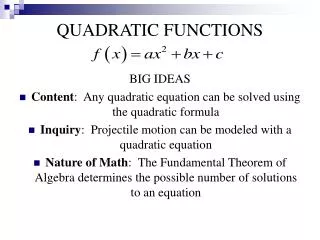
Functions 1. Linear function (straight line) (y=mx+b) m= slope b=y intercept 2. Quadratic function (Parabola) y=x2
Always negative Completing the Square • Divide 6 by 2 and fill it in the first blank • Square 3 and place the answer in the second blank • Simplify the numbers y=x2+6x-7 y=(x+__)2-__-7 y=(x+3)2 -__-7 y=(x+3)2-9 -7 y=(x+3)2-16
Divide everything by two in order to get rid of the 2 attached to the X2 Then continue as before Completing The Square y=2x2+24x -8 2 y=2[x2+12x -4] y=2[(x+6)2-36 -4] y=2[(x+6)2 -40]
Characteristics of Quadratic Function y=x2 y=½x2 y=-x2
y=x2 - 2 y=x2 + 2 y=-(x+2)2
y=2x2 y=(x+2)2-5 Y=(x-3)2 -3
y=-(x-4)2 +3 y=-(x+2)2 y=(x-2)2 -3
y= -(x)2 -2 y= (x-4)2+3 y=(x-1)2