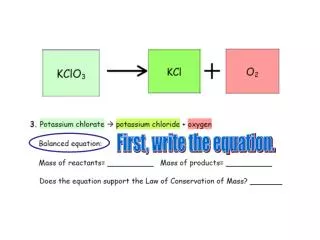
Balancing Chemical Equations and Calculating Mass of Reactants
This guide explains how to write balanced chemical equations, count the number of atoms on each side, and calculate the mass of reactants. It includes a step-by-step process for determining atomic masses using the periodic table, specifically for potassium (K), chlorine (Cl), and oxygen (O). By following the examples provided, learners will practice counting atoms and summing atomic masses to find the total mass of reactants in chemical reactions, ensuring accurate representations in chemical equations.

Balancing Chemical Equations and Calculating Mass of Reactants
E N D
Presentation Transcript
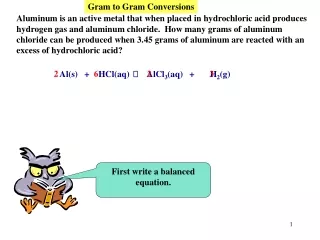
Count the number of atoms on each side of the equation. K - _____ Cl - _____ O - _____ K - _____ Cl - _____ O - _____
Count the number of atoms on each side of the equation. 1 K - _____ Cl - _____ O - _____ K - _____ Cl - _____ O - _____ 1 = 1 1 = 3 2
Count the number of atoms on each side of the equation. 2x3=6 2 1 2 K - _____ Cl - _____ O - _____ K - _____ Cl - _____ O - _____ 1 = 1 2 1 = 3 6 2
Count the number of atoms on each side of the equation. 2 2 1 2 K - _____ Cl - _____ O - _____ K - _____ Cl - _____ O - _____ 1 2 = 1 2 1 2 = 3 6 2
Count the number of atoms on each side of the equation. 3x2=6 2 2 3 1 2 K - _____ Cl - _____ O - _____ K - _____ Cl - _____ O - _____ 1 2 = 1 2 1 2 = 3 6 2 6
Count the number of atoms on each side of the equation. 2 2 3 1 2 K - _____ Cl - _____ O - _____ K - _____ Cl - _____ O - _____ 1 2 = 1 2 1 2 = 3 6 2 6 =
To find the mass of the reactants: • Find each element on the Periodic Chart • Find the Atomic Mass for each element • Add the atomic mass for each atom to get the total mass for the reactants
78 K (potassium) has an atomic mass of 39. K (potassium) has an atomic mass of 39. There are 2 K (potassium) atoms. There are 2 K (potassium) atoms. 2x39= 78 2x39= 78
78 +70 Cl (chlorine) has an atomic mass of 35. There are 2 Cl (chlorine) atoms. 2x35= 70
78 +70 +96 2x3=6 O (oxygen) has an atomic mass of 16. There are 6 O (oxygen) atoms. 6x16= 96
78 +70 +96 =244
78 K (potassium) has an atomic mass of 39. There are 2 K (potassium) atoms. 2x39= 78
78 +70 =148 Cl (chlorine) has an atomic mass of 35. There are 2 Cl (chlorine) atoms. 2x35= 70
148 96 3x2=6 O (oxygen) has an atomic mass of 16. There are 6 O (oxygen) atoms. 6x16=96
148 96 148+96=244
244 244 YES