

SlideServe
Menu
Préférences
© SlideServe · v2026

Operation Torch

brasen avatar
10 diapositives · 1.6K Views · Jul 27, 2014

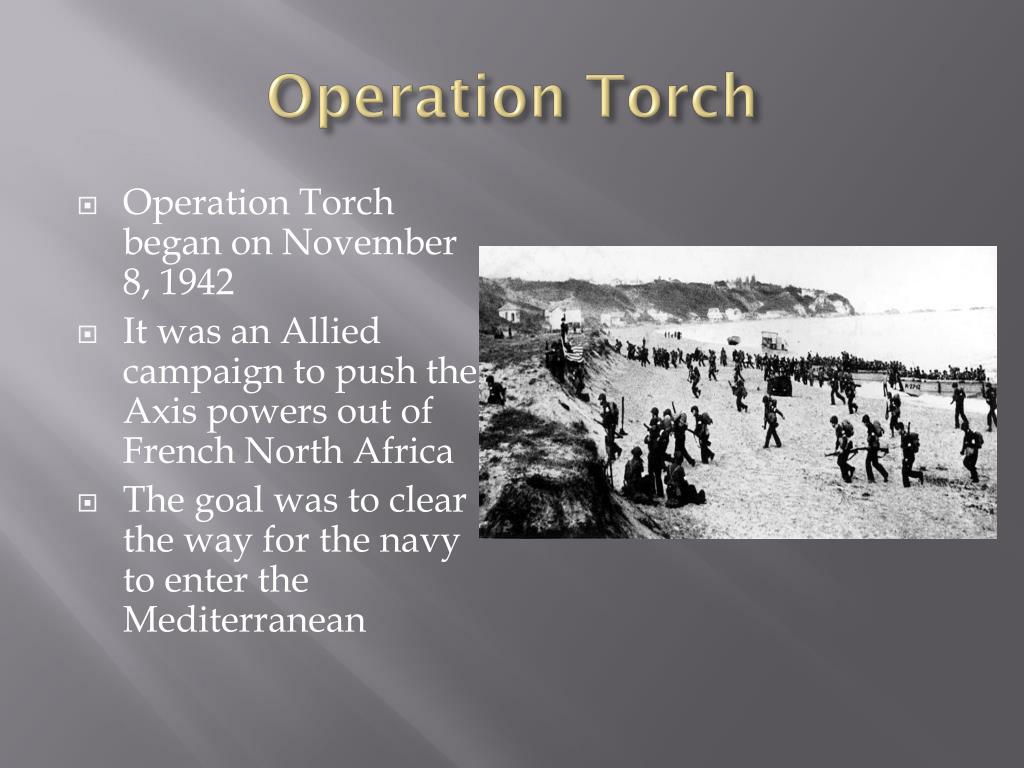
Operation Torch. Operation Torch began on N ovember 8, 1942 It was an Allied campaign to push the Axis powers out of French North Africa The goal was to clear the way for the navy to enter the Mediterranean. The assaulting force was split into three task forces
Operation Torch - slide 1
01 / 10Operation Torch
1 / 17

Télécharger la présentation

Operation Torch
Une image / un lien ci-dessous est fourni (tel quel) pour télécharger la présentation

Politique de téléchargement : le contenu du site vous est fourni TEL QUEL pour votre information et votre usage personnel ; il ne peut être vendu, concédé sous licence ni partagé sur d’autres sites sans l’accord de son auteur.Le contenu vous est fourni TEL QUEL, pour votre information et votre usage personnel uniquement. Téléchargez la présentation en cliquant sur ce lien. Lors du téléchargement, si vous ne parvenez pas à télécharger une présentation, l’éditeur a peut-être supprimé le fichier de son serveur.Pendant le téléchargement, si vous ne parvenez pas à obtenir une présentation, le fichier a peut-être été supprimé par l’éditeur.

F I N

Plus de contenu associé

Transcription de la présentation
  1. Operation Torch • Operation Torch began on November 8, 1942 • It was an Allied campaign to push the Axis powers out of French North Africa • The goal was to clear the way for the navy to enter the Mediterranean

  2. The assaulting force was split into three task forces • General Patton was in command of the western task force responsible for Casablanca • These assaults were then followed by a push into Tunisia

  3. Casablanca • It was decided that the western attack force wouldn’t utilise a preliminary bombardment, as it was hoped that the French would not resist the Allies • This was the wrong move, as the French proceeded to retaliate against the invading forces

  4. The assault on Oran was impeded by unexpected resistance • This was due to the lack of proper reconnaissance on the landing areas. • Airborne troopers captures the airports, allowing the success of the amphibious assault.

  5. Algiers • The French resistance fighters staged a planned coup in the cities • This allowed the Eastern Task Force to take the ports with much less resistance

  6. Tunisia • After the three pronged assault the Allies consolidated their power and pushed into Tunisia • After a struggle from Rommel, the Axis forces were defeated. • Rommel was replaced before the final battles, allowing him to participate in more conflicts

  7. Battle of Dieppe • Was an Allied attack on the German occupied port of Dieppe • Started on the 19th of August, 1942 • The plan was to take the port, and hold it for two tides and destroy the defences present before withdrawing.

  8. The Battle of Dieppe served as a guide as what not to do in amphibious operations • There was no artillery support, or aerial bombardment • No element of surprise • Lack of reconnaissance

  9. Needless to say, Dieppe was an operational failure for the Allies • The Canadians lost 3367 men, while the Germans lost 311, almost 10 times less • The objectives were not met

  10. https://en.wikipedia.org/wiki/Dieppe_Raid • http://en.wikipedia.org/wiki/Operation_Torch • https://encrypted-tbn2.gstatic.com/images?q=tbn:ANd9GcQBPSaUyKCyXJyE6KbAaCATYpbyjkbIUs3t338ZX_HFc9rr3wRirA • https://encrypted-tbn3.gstatic.com/images?q=tbn:ANd9GcRp_pZHhpPzl-0lJzOFZLdE6NA8SRvcLz0_u2JNooi9MfDH_kwN7Q