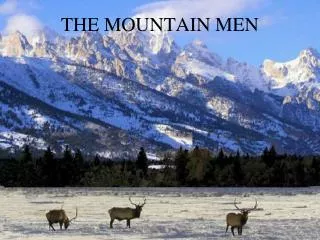
THE MOUNTAIN MEN
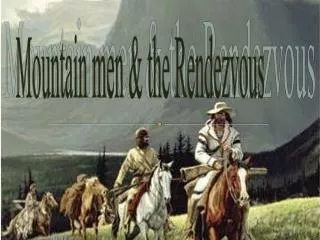
THE MOUNTAIN MEN. MOUNTAIN MEN. Prime period 1820-1840 Only about 200-300 a year Lured by the west Opportunity to make money. Illiterate Uneducated Primitive Relatively young Reckless Adventuresome In need of money However, some had college degrees and were very refined.

THE MOUNTAIN MEN
E N D
Presentation Transcript
MOUNTAIN MEN • Prime period 1820-1840 • Only about 200-300 a year • Lured by the west • Opportunity to make money
Illiterate Uneducated Primitive Relatively young Reckless Adventuresome In need of money However, some had college degrees and were very refined CHARACTERISTICS OF A MOUNTAIN MAN
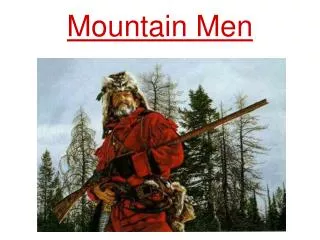
DESCRIPTION OF MT MEN • Many were very large-Natives looked at them with awe and superstition • Eventually occupation developed lifestyle, conduct and habits, a culture of their own • Harsh language • Smelly and dirty • They never laundered their buckskin suit and seldom removed it
DESCRIPTION • Many mountain men were more savage than Natives • Little concern for family or comforts • Not materialistic • Traveled with a rifle,skinning knife, horse, traps and utensils
DESCRIPTION • Ate well at times and poorly at others • Cut off horses tail and ears to make stew • Tapped into horses veins • Ate moccasins, ants, black crickets, deer excrement soup, bark and berries • Explored trails & helped name the west • Traders gave Indians the whiskey trade, small pox, diphtheria and cholera • Trapped themselves out of business by the 1840’s
TRAPPERS • Trappers were divided into three categories • Free trapper-Unaffiliated, unfettered, most colorful and romantic • Company trapper-Affiliated with a company • Fur trader-Did not trap, but traded with Indians (The whiskey trade was his bonanza)
Where trappers sold pelts: • Either in Taos, New Mexico • Caravan that brought supplies to annual “rendezvous”
Taos • A wild city, north of Santa Fe Trail • Pelts were sold • Supplies purchased • Gambling, whiskey, women
Rendezvous • Different location each year in Wyoming or Utah • Fur companies brought boats and wagons filled with supplies • Weeklong party, dancing, story telling, trading • Mountain men left penniless
Hudson Bay Company • 1670 • British • Still operating-sells blankets • Dominated fur industry in Northern Rocky Mountains during the trappers era • 250,000 skins sold in Europe • One man earned $50,000 in one year
Missouri Fur Company • 1808 • First in the US • Owner was Manuel Lisa • Base-Omaha • Operated upper Missouri River system • 1811-sent trappers to upper Arkansas River
American Fur Company • 1808 • Operates in Yellowstone River system • Owner-John Jacob Astor (America’s first millionaire) • 1811- Made settlement on Columbia river to expand industry into NW
Rocky Mountain Fur Company • 1822 • Upper Missouri River • First Rocky Mountain success • 1834-Was sold to American Fur Company
MOUNTAIN MEN • 1840’s saw the end of the Mountain Men • Silk hats had replaced the beaver skin hat so there was no longer a market • The rendezvous had been replaced by the trading post
Legacy of Mountain Men Discovered trail & passes Established relations with Native Americans Established trade routes and trails west
TRADE • 1821-Mexican Independence (Spain had not allowed Mexicans to trade with Americans) • William Becknell quickly took advantage of this and became known as the “father of Santa Fe Trade” • Raiding Indians became a problem-Government marked the trail and provided escorts
TRADE • Santa Fe Trail was in its prime from 1820-1870 • Preceded the Oregon Trail, the 49ers and the 59ers • Manufactured goods from the east sent west for pelts, blankets and whiskey • Tough trip because of long stretches without contact with civilization, natural barriers and Indian problems
BENT’S FORT • Charles (25 and a West Point graduate) and William (15) headed west to find their future • To enter the fur trading business- carried trinkets to help trade • Located along the Arkansas River (wood and water available) • Established a good relationship with Indians, purchased pelts
BENT’S FORT • 1833-Chose a site on the Arkansas River • Ceran St. Vrain suggested the Spanish style (Bent, St. Vrain & Company) • Chose the high ground • Adobe instead of wood because: • Wood was scarce • Did not burn • Warm in the winter and cool in the summer
BENT’S FORT • Tried to provide eastern culture (White tablecloths, imported china and a wine cellar) • Permanent employees-Blacksmiths, carpenters, gunsmiths and hunters • Six different languages spoken-French, Spanish, German, English, Comanche and Arapaho
BENT’S FORT • William Bent married a Cheyenne woman-Good relations with Indians • US annexed Texas in 1845 –Mexicans viewed this as an act of war • Bent’s Fort was used as an advance base and rendezvous for General Kearney (1650 troops); because of this trade stopped
BENT’S FORT • Charles Bent had been appointed governor of newly annexed New Mexico • He was killed by the Mexicans and the Pueblo Indians • St Vrain sold his interest in the fort to William • Army wanted to buy it from him • The fort was burned to the ground • Did not like the price • Possibly cholera • Built a second fort 38 miles away
OTHER TRADING POSTS • Ft Robidoux • Ft Davy Crockett (nw colorado) • Ft Lupton (S. Platte) • Ft St. Vrain • Forts died out • Indian trade fell • Silk Hats • Buffalo robes were plentiful