Mastering Integration by Parts: A Comprehensive Guide to Evaluating Integrals
This guide focuses on the technique of integration by parts, essential for integrating products of functions without a u-substitution. It outlines step-by-step guidelines for choosing appropriate functions, u and dv, and provides numerous examples to practice this technique. It emphasizes the importance of experience in finding the best choices for integration to simplify the process. With the helpful acronym LIATE to remember the order of function categories, this resource is designed for students looking to enhance their integral calculus skills.

Mastering Integration by Parts: A Comprehensive Guide to Evaluating Integrals
E N D
Presentation Transcript
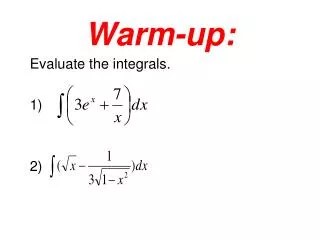
Warm-up: Evaluate the integrals. 1) 2)
Warm-up: Evaluate the integrals. 1) 2)
Warm-up: Evaluate the integrals. 1) 2)
Integration by Parts Section 8.2 Objective: To integrate problems without a u-substitution
Integration by Parts • When integrating the product of two functions, we often use a u-substitution to make the problem easier to integrate. Sometimes this is not possible. We need another way to solve such problems.
Integration by Parts • As a first step, we will take the derivative of
Integration by Parts • As a first step, we will take the derivative of
Integration by Parts • As a first step, we will take the derivative of
Integration by Parts • As a first step, we will take the derivative of
Integration by Parts • As a first step, we will take the derivative of
Integration by Parts • Now lets make some substitutions to make this easier to apply.
Integration by Parts • This is the way we will look at these problems. • The two functions in the original problem we are integrating are u and dv. The first thing we will do is to choose one function for u and the other function will be dv.
Example 1 • Use integration by parts to evaluate
Example 1 • Use integration by parts to evaluate
Example 1 • Use integration by parts to evaluate
Example 1 • Use integration by parts to evaluate
Example 1 • Use integration by parts to evaluate
Guidelines • The first step in integration by parts is to choose u and dv to obtain a new integral that is easier to evaluate than the original. In general, there are no hard and fast rules for doing this; it is mainly a matter of experience that comes from lots of practice.
Guidelines • There is a useful strategy that may help when choosing u and dv. When the integrand is a product of two functions from different categories in the following list , you should make u the function whose category occurs earlier in the list. • Logarithmic, Inverse Trig, Algebraic, Trig, Exponential • The acronym LIATE may help you remember the order.
Guidelines • If the new integral is harder that the original, you made the wrong choice. Look at what happens when we make different choices for u and dv in example 1.
Guidelines • If the new integral is harder that the original, you made the wrong choice. Look at what happens when we make different choices for u and dv in example 1.
Guidelines • Since the new integral is harder than the original, we made the wrong choice.
Example 2 • Use integration by parts to evaluate
Example 2 • Use integration by parts to evaluate
Example 2 • Use integration by parts to evaluate
Example 2 • Use integration by parts to evaluate
Example 2 • Use integration by parts to evaluate
Example 3 (S): • Use integration by parts to evaluate
Example 3 • Use integration by parts to evaluate
Example 3 • Use integration by parts to evaluate
Example 3 • Use integration by parts to evaluate
Example 3 • Use integration by parts to evaluate
Example 4 (Repeated): • Use integration by parts to evaluate
Example 4 (Repeated): • Use integration by parts to evaluate
Example 4 (Repeated): • Use integration by parts to evaluate
Example 4 (Repeated): • Use integration by parts to evaluate
Example 4 (Repeated): • Use integration by parts to evaluate
Example 4 (Repeated): • Use integration by parts to evaluate
Example 4 (Repeated): • Use integration by parts to evaluate
Example 4 (Repeated): • Use integration by parts to evaluate
Example 5: • Evaluate the following definite integral
Example 5: • Evaluate the following definite integral
Example 5: • Evaluate the following definite integral
Example 5: • Evaluate the following definite integral
Example 5: • Evaluate the following definite integral
Example 5: • Evaluate the following definite integral
Example 5: • Evaluate the following definite integral
Example 5: • Evaluate the following definite integral
Example 5: • Evaluate the following definite integral
Example 5: • Evaluate the following definite integral