SlideServe
Menu
Préférences
© SlideServe · v2026

Core Promoters & Transcription Start Sites

brett-potter avatar
10 diapositives · 241 Views · Nov 20, 2014

This article explores core promoters and their roles in gene regulation, focusing on transcription start sites (TSS) and associated sequence motifs such as Inr, TATA box, DPE, and DRE. It discusses methodologies for identifying TSS through full-length cDNAs, cap-trapped libraries, and whole genome tiling arrays. Key findings include the significance of DNase I hypersensitive sites and the application of computational methods in promoter prediction, highlighting advancements in annotation and gene expression analysis in Drosophila.
Core Promoters & Transcription Start Sites - slide 1
01 / 10Core Promoters & Transcription Start Sites
1 / 17

Télécharger la présentation

Core Promoters & Transcription Start Sites
Une image / un lien ci-dessous est fourni (tel quel) pour télécharger la présentation

Politique de téléchargement : le contenu du site vous est fourni TEL QUEL pour votre information et votre usage personnel ; il ne peut être vendu, concédé sous licence ni partagé sur d’autres sites sans l’accord de son auteur.Le contenu vous est fourni TEL QUEL, pour votre information et votre usage personnel uniquement. Téléchargez la présentation en cliquant sur ce lien. Lors du téléchargement, si vous ne parvenez pas à télécharger une présentation, l’éditeur a peut-être supprimé le fichier de son serveur.Pendant le téléchargement, si vous ne parvenez pas à obtenir une présentation, le fichier a peut-être été supprimé par l’éditeur.

F I N

Plus de contenu associé

Transcription de la présentation
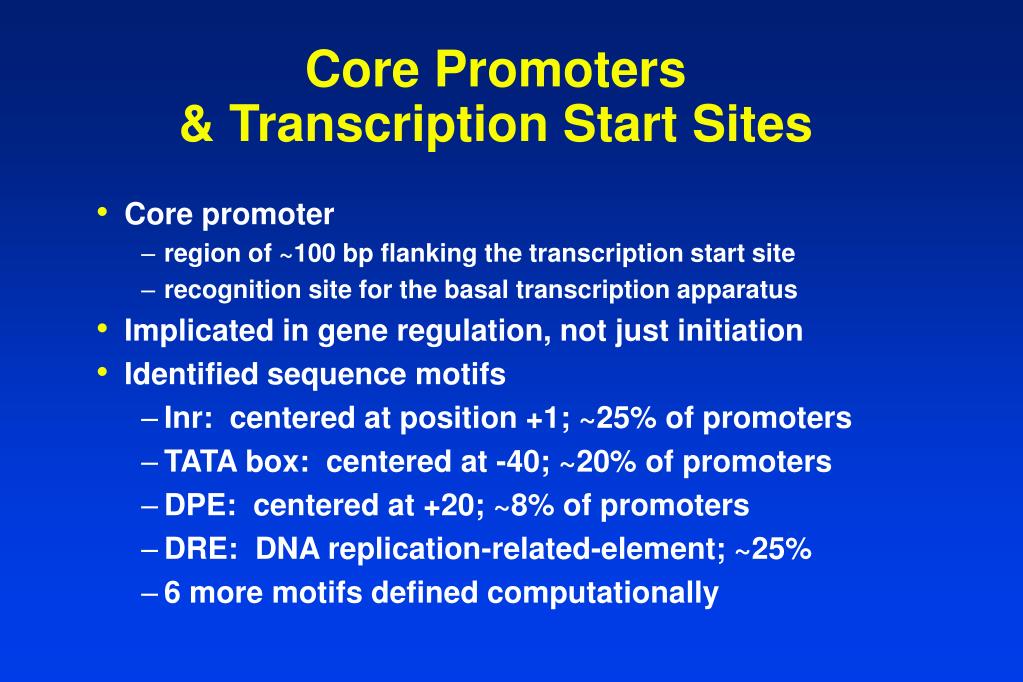
  1. Core Promoters & Transcription Start Sites • Core promoter • region of ~100 bp flanking the transcription start site • recognition site for the basal transcription apparatus • Implicated in gene regulation, not just initiation • Identified sequence motifs • Inr: centered at position +1; ~25% of promoters • TATA box: centered at -40; ~20% of promoters • DPE: centered at +20; ~8% of promoters • DRE: DNA replication-related-element; ~25% • 6 more motifs defined computationally

  2. Transcription Start Sites • Full-Length cDNAs • Cap-trapped libraries • 5’ ESTs & directed cDNA screening • 5’ RACE & primer extension • Whole genome tiling arrays • Tissue- and stage-specificity • Alternative 5’ exons • Comparative genomics may help

  3. Core Promoter Prediction: Example of Ohler et al. 2002 • Selected ~2,000 clusters of 5’ ESTs • ≥ 3 ESTs within 11 bp • ≥ 1 cap-trapped EST • 5’-most EST defines position +1 • Find overrepresented words • Search within -60 to +40 • MEME finds 10 sequence motifs: 4 known and 6 novel • Re-train and run McPromoter • Evaluate on Adh region and chromosome arm 2R • Sensitivity / Specifity = 65% / 29% to 19% / 69% (threshold-dependent) • Conclusion: Good enough to direct wet lab experiments

  4. P-elements Target Promoters • > 50,000 mapped insertions • Insertions associated with 40% of genes

  5. Drosophila Promoter Annotation P-element insertion sites Promoter predictions Curated gene models - open boxes = 5’UTRs

  6. DNase I Hypersensitive Sites • Sites of Accessible or “Open” Chromatin • Southern Blot Assay Method • Partial digestion of chromatin with DNase I • Complete digestion with a restriction enzyme • Southern blot to identify and locate site(s) • DNase digest is partial, so fragments are size-fractionated prior to detection • Related Methods • Restriction enzyme hypersensitivity • Chemical modification

  7. Additional Methods • ENCODE Methods • ChIP-chip of proteins at promoters • RNA pol II, TBP, etc. • Transfection of reporter constructs • DNase I hypersensitive sites • EST-like sequencing of plasmid libraries • Quantitative PCR detection • Other Approaches • In vitro transcription assays • What else?

  8. Sample ENCODE Region (Fig.3) • Promoter finding methods correlate with each other and with 5’ exons • Functional assays of constructs look good • RNA Pol II ChIP-chip can be very effective and scales to the genome • DNaseI hypersenstitve sites correlate with promoters • Some genes appear to have promoters at both ends: antisense?

  9. Summary of Methods • Transcription Start Sites • 5’-ESTs, cDNA screening, and 5’-RACE are scalable • Whole genome tiling array hybridization is a key • Core Promoters • ChIP-chip with promoter-associated proteins is a key • Reporter constructs tested in functional assays in fly cells? • DNase hypersensitve sites • Will high-throughput methods be effective and scalable? • Are hypersenstive sites mostly promoters? • Computational Methods • Refinements to promoter prediction • Comparative sequence analysis • Comparative promoter prediction?

  10. Promoter Annotation in Drosophila • ~14,000 protein-coding genes • >10,000 associated with 5’ ESTs • How many alternative promoters? • Release 3 annotation suggests ≥ 3% of genes • How many non-protein-coding genes? • Project Scale: ~20,000 fly promoters?