Download
1 / 24
260 likes | 401 Vues
This study explores the operant conditioning of cortical activity, focusing on how motor units and voluntary control correlate with neuronal firing rates. Using reaching tasks for rewards as an experimental paradigm, the research investigates the modulators influencing firing rates in the motor cortex. The findings include insights into real-time control of robotic arms using recorded neurons and critical assessments of the relationship between physical and imaginary movements in neural signals. The implications for practical applications and neuroengineering are discussed, highlighting potential challenges and advancements.

E N D
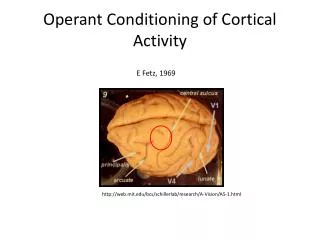
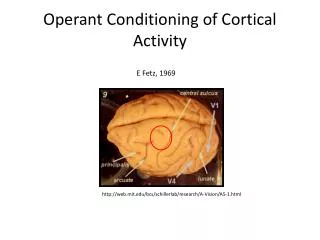
Operant Conditioning of Cortical Activity E Fetz, 1969 http://web.mit.edu/bcs/schillerlab/research/A-Vision/A5-1.html
Background • Many foundations considered a given now • Muscle – motor unit correlation • Voluntary control of activity • Operant conditioning of firing
Design • Goal: Determine modulator(s) • Experimental Paradigm • Controls (What could modulate firing rate?) • Stimuli • Reaching for pellet • Getting a pellet
Methods Jackson 2007
Results Avg. Wave ISIs Different feedback modalities / subjects
Summary / Criticisms • Modulation of firing rate is reward bound • Do documentation of movement, what is the monkey learning to do?
Real-time control of a robot arm using simultaneously recorded neurons in the motor cortex. Chapin et al. 1999
Lever-movement/robot-arm mode Water Dispenser Robot Arm Lever
Trials # What does spatio-temporal mean in this context? Time from movement onset (s)
NP-function/robot-arm mode Water Dispenser Robot Arm Lever
NP-function/robot-arm mode Did not press the lever, but still continued to reach
Was it the rats’ “imaginary movement” that triggered the robot-arm movement? • The decoder did not discriminate physical movements and imaginary movements in neural signal. What kind of potential drawbacks could that make in real application? • What kind of additional signals could potentially help discriminate physical vs imaginary movements?
Real-Time prediction of hand trajectory by ensembles of cortical neurons in primates Wessberg et al. 2000
Background • Builds on previous paper, can “binary” decision be expanded to an analog signal? • Primary and secondary motor cortices involved in reaching tasks (M1, PMd, PP)
Experiment • Hypotheses • 1-D and 3-D prediction • Task dependent activation • Linear vs. Non-linear Models • Control External Device • Experimental Overview
Methods - Recording Nieder 2005
Methods - Models Regression (linear) Firing rates Weights Artificial Neural Network (non-linear) Regression intercepts Error Position
Discussion / Criticisms • Max accuracy with short training times (10 minutes) • Generalizability of classifier • Relative contributions of motor areas • More neurons != more accuracy. Why? • Why does PMd contribute to better decoding w/ fewer neurons? • Real time decoding different from offline decoding (ANNs better in offline, just more computationally expensive) • Assumption of hyperbolic relationship, limited in extrapolation • Engineering application is showy, but open loop.