Understanding Mechanical Energy: Kinetic and Potential Energy Explored
40 likes | 174 Vues
Mechanical energy is the sum of kinetic energy (the energy of motion) and potential energy (stored energy based on position). An object possesses mechanical energy if it is in motion or at a position relative to a defined zero potential energy level, such as a brick held above the ground. This concept extends to various everyday activities like throwing a football, hitting a baseball, or riding a horse, illustrating the practical implications of mechanical energy in our lives.


Understanding Mechanical Energy: Kinetic and Potential Energy Explored
E N D
Presentation Transcript
By: Julie Jevahirian. Jacob Anderson, Tess Helfrich, and Josh Gates Mechanical Energy
Mechanical energy can be either kinetic energy (energy of motion) or potential energy (stored energy of position). Objects have mechanical energy if they are in motion and/or if they are at some position relative to a zero potential energy position (for example, a brick held at a vertical position above the ground or zero height position). Source: http://www.glenbrook.k12.il.us/gbssci/ph… Definition
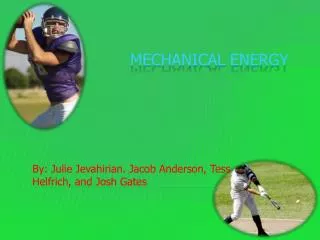
Throwing a football Hitting a baseball Diving into water Jumping on a trampoline Running the mile Riding a horse Accelerating a car Examples
http://en.wikipedia.org/wiki/Mechanical_energy http://www.glenbrook.k12.il.us/gbssci/phys/Class/energy/u5l1d.html http://www.cpast.org/Articles/fetch.adp?topicnum=27 Links With Good Info