SlideServe
Menu
Préférences
© SlideServe · v2026

Unit 7 - Absolute Temperature

brielle-macdonald avatar
10 diapositives · 385 Views · Nov 19, 2014

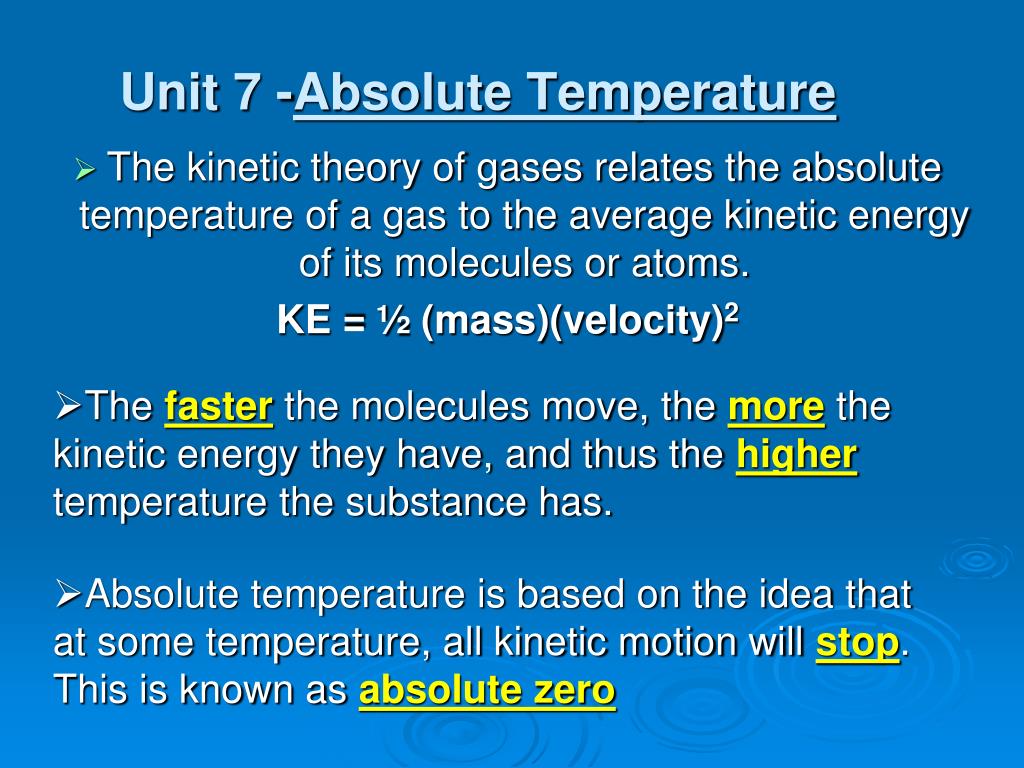
Unit 7 - Absolute Temperature. The faster the molecules move, the more the kinetic energy they have, and thus the higher temperature the substance has. The kinetic theory of gases relates the absolute temperature of a gas to the average kinetic energy of its molecules or atoms.
Unit 7 - Absolute Temperature - slide 1
01 / 10Unit 7 - Absolute Temperature
1 / 17

Télécharger la présentation

Unit 7 - Absolute Temperature
Une image / un lien ci-dessous est fourni (tel quel) pour télécharger la présentation

Politique de téléchargement : le contenu du site vous est fourni TEL QUEL pour votre information et votre usage personnel ; il ne peut être vendu, concédé sous licence ni partagé sur d’autres sites sans l’accord de son auteur.Le contenu vous est fourni TEL QUEL, pour votre information et votre usage personnel uniquement. Téléchargez la présentation en cliquant sur ce lien. Lors du téléchargement, si vous ne parvenez pas à télécharger une présentation, l’éditeur a peut-être supprimé le fichier de son serveur.Pendant le téléchargement, si vous ne parvenez pas à obtenir une présentation, le fichier a peut-être été supprimé par l’éditeur.

F I N

Plus de contenu associé

Transcription de la présentation
  1. Unit 7 -Absolute Temperature • The faster the molecules move, the more the kinetic energy they have, and thus the higher temperature the substance has. The kinetic theory of gases relates the absolute temperature of a gas to the average kinetic energy of its molecules or atoms. KE = ½ (mass)(velocity)2 • Absolute temperature is based on the idea that at some temperature, all kinetic motion will stop. This is known as absolute zero

  2. Kelvin Temperature Scale • The Kelvin temperature scale was created to eliminate negative temperature values. • 0 degrees Kelvin is considered absolute zero, or where there is no molecular motion. • There is no temperature lower than 0 Kelvin, and we can never get to 0 Kelvin. • 0 Kelvin = - 273 oC • Kelvin = oC + 273 • ***All temperatures must be in the Kelvin temperature scale when using the gas laws!

  3. Absolute Zero video clip P -273oC Temperature , oC

  4. Charles’ LawVolume and Temperature • The volume and the temperature of a gas are directly proportional when the pressure and number of moles remain constant. V1 = V2 T1 T2 • Temperature is in Kelvin. K = oC + 273 V T (K)

  5. Charles’ Law

  6. Charles’ Law Video

  7. Sample Problem The volume of a bubble is 1.5 liters. If its temperature increases from 20 to 50 oC, what is its final volume? V1 = V2 V1 = 1.5 L T1 = 20oC T1 T2 V2 = ? T2 = 50oC First convert Temperatures to Kelvin!!!! T1 = 20 + 273 = 293 K T2 = 50 + 273 = 323 K (293K)V2 = (1.5L)(323K) 1.5 L = V2 293K 323K V2 = 1.65 L

  8. Guy – Lussac’s LawPressure and Temperature • The pressure of a gas is directly proportional to its temperature (when volume and the number of moles remain constant). • P1 = P2 T1 T2 • Temperature in Kelvin K = oC + 273 P T (K)

  9. Sample Problem • If a child has a rigid ball with 25 atm of pressure at 22 oC, what will the pressure be at 0 oC? P1 = P2 P1 = 25atm T1 = 22oC T1 T2 P2 = ? T2 = 0oC First Convert Temperature to Kelvin! T1 = 22oC + 273 = 295K T2 = 0 oC + 273 = 273K P2(295K) = (25atm)(273K) 25 atm = P2 295K 273K P2 = 23.1 atm

  10. Why we can’t get to Absolute Zero