Understanding Photoreceptors: The Role of Rhodopsin and Iodopsin in Vision
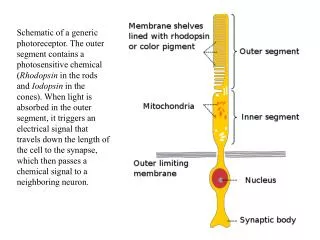
This diagram illustrates the structure and function of photoreceptors, focusing on the outer segment where light-sensitive proteins, Rhodopsin in rods and Iodopsin in cones, are located. Upon light absorption, these proteins initiate an electrical signal that travels through the photoreceptor cell to the synapse, where it is converted into a chemical signal and communicated to neighboring neurons. This vital process is key to vision and exemplifies the intricate connection between light and neurological response.

Understanding Photoreceptors: The Role of Rhodopsin and Iodopsin in Vision
E N D
Presentation Transcript
Photoreceptor scheme Schematic of a generic photoreceptor. The outer segment contains a photosensitive chemical (Rhodopsin in the rods and Iodopsin in the cones). When light is absorbed in the outer segment, it triggers an electrical signal that travels down the length of the cell to the synapse, which then passes a chemical signal to a neighboring neuron.