Stellar evolution and star clusters
Stellar evolution and star clusters. Key variable is mass of star directly measured only for binary stars, but it determines position on main sequence. Cluster ages. Main-sequence luminosity increases much faster than mass therefore massive stars use up their fuel much faster

Stellar evolution and star clusters
E N D
Presentation Transcript
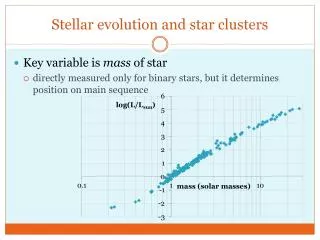
Stellar evolution and star clusters • Key variable is mass of star • directly measured only for binary stars, but it determines position on main sequence
Cluster ages • Main-sequence luminosity increases much faster than mass • therefore massive stars use up their fuel much faster • therefore their lifetimes on main sequence are much shorter • therefore age of cluster can be found from the location of the top of its main sequence • confirm this with the length and strength of the red giant branch: the longer the RGB and the further down it goes, the older the cluster • any HR diagram showing both a clear upper main sequence and a long red giant branch is not a single-age population • but in real HR diagrams don’t be fooled by scattered bad measurements/foreground stars
Examples a few very bright RGs horizontal branch turn-off point near B0 lots of RGs K & M stars not on MS yet turn-off point near F/G Very young cluster h & χPersei Globular cluster M15
Examples nearby stars IC 1613
Effect of heavy element content Horizontal branch extends further to the left for lower (initial) heavy element content
Stellar evolution • Step 0: pre main sequence • gas cloud collapses under gravity • this will make it spin faster and form a disc (later planets) • lost gravitational potential energyis partly converted to internal heatand partly radiated away • star is large, cool and quite luminous • eventually core gets hot enoughto fuse hydrogen • star has reached main sequence
Stellar evolution • Step 1: main sequence • fusing hydrogen to helium in core • star will spend ~90% of its lifetime here • luminosity and colour (surfacetemperature) depend on mass • more massive star will be hotterand much brighter (L ∝M3.5 or so) • surface temperature and chemicalcomposition can be determinedfrom spectrum • eventually core hydrogen willrun out
Stellar evolution • Step 2: subgiant and red giant • fusing hydrogen to helium in shell around helium core • this is not a stable situation • H fusing shell gets hotter,generates more energy andpressure • star expands, cools and gets brighter • moves along subgiant branch andup red giant branch • eventually core helium gets hotenough to fuse • note star does not run out of H!
Stellar evolution • Step 3: horizontal branch • fusing helium to carbon in core • position depends on (initial) heavy element content • lower-metallicity stars hotter • stable, but lasts <10% as long as main sequence because helium fusion is only 10% as efficient(and star is brighter now) • eventually core helium willrun out
Stellar evolution • Step 4: second red giant branch (asymptotic GB) • fusing helium to carbon in shell around carbon core • very unstable indeed • later, hydrogen fusion turns on again in second shell • very severe mass loss in stellar wind • eventually all outer layers are blown off, causing fusion to stopand leaving very hot carbon core
Stellar evolution • Step 5: planetary nebula and white dwarf • carbon core will ionise and excite surrounding gas, making it glow • planetary nebula • gas will eventually dissipate,leaving behind small, hot white dwarf • which will just cool off as it gets older
Massive stars • Differences from lower-mass (<8 solar masses) • much shorter lifetime • luminosity does not change much as they evolve (though colour does) • after He fusion, will repeat process with steadily heavier elements until iron core forms • iron fusion does not generate energy, so collapse of iron core is catastrophic • core produces neutron star or black hole, rest of star bounces off core to produce supernova explosion