Converting Moles to Particles: Essential Calculations for Chemistry Students
This guide covers essential conversion factors for moles and particles in chemistry, focusing on how to convert from moles to particles and vice versa using Avogadro's number (6.022 x 10^23). It provides examples of calculating moles from given particle counts for various compounds, including aluminum sulfate and iron(III) hydroxide, as well as how to determine the mass of substances given in moles. With practice problems and a summary of molar mass concepts, this guide supports homework assignments and reinforces understanding of these fundamental chemistry principles.

Converting Moles to Particles: Essential Calculations for Chemistry Students
E N D
Presentation Transcript
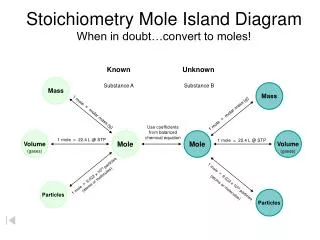
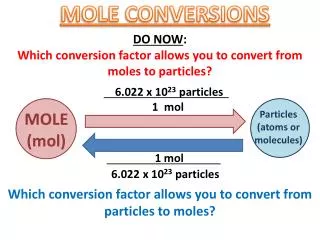
MOLE CONVERSIONS DO NOW: Which conversion factor allows you to convert from moles to particles? Particles (atoms or molecules) MOLE (mol) Which conversion factor allows you to convert from particles to moles? 1 mol . 6.022 x 10²³ particles . 1 mol 6.022 x 10²³ particles
HOMEWORK Read 8.4 #’s 19,21,23,38,40,42
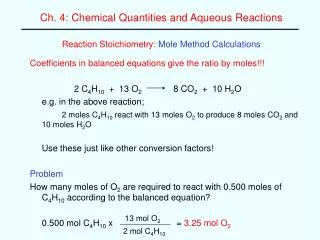
( ) aluminumsulfate aluminumsulfate How many moles of are in 6.29 x 1024 SO42– Al3+ molecules of Al2(SO4)3? Al2(SO4)3 1 mol Al2(SO4)3 6.29 x 1024m’cAl2(SO4)3 = 10.4 mol 6.022 x 10²³m’c Al2(SO4)3 Al2(SO4)3 P mole M P
( ) How many molecules are in 3.15 mol of iron (III) hydroxide? Fe3+ OH1– Fe(OH)3 6.022 x 10²³m’c Fe(OH)3 3.15 mol Fe(OH)3 1 mol Fe(OH)3 = 1.90 x 1024 molecules Fe(OH)3 P mole M P
( ) How many grams are in 5.16 mol magnesium? Mg 24.31 g Mg 5.16 mol Mg = 125.4 g Mg 1 mol Mg P MOLAR MASS! mole M
( ) What’s the mass of 1.29 mol ? iron (II)nitrate iron (II)nitrate P NO31– Fe(NO3)2 Fe2+ 179.87 g Fe(NO3)2 mol = 232 g Fe(NO3)2 1.29 mol Fe(NO3)2 1 mol Fe(NO3)2 M P MOLAR MASS of Fe(NO3)2 1 formula unit of Fe(NO3)2contains... 1 iron atom 2 nitrogen atoms 6 oxygen atoms
QUICK SUMMARY g amu 6.022x10²³ Molar Massvs.Atomic Mass 1.01 g H = _____ H = _______ 1 amu 18.02 g H2O = _____ H2O = ________ 18 amu 120.39 g MgSO4 = _____ MgSO4 = ________ 120 amu 149.12 g (NH4)3PO4 = _____ (NH4)3PO4 = ________ 149 amu
MOLAR MASS PRACTICE… (NH4)3PO4 HNO3 Nitric Acid Ammonium Phosphate
( ) potassium nitrate potassium nitrate How many mol are in 37.5g of ? NO31– KNO3 K1+ P 1 mol KNO3 37.5 g KNO3 = 0.371 mol KNO3 mole 101.11 g KNO3 M P MOLAR MASS of KNO3 1 formula unit of KNO3contains... 1 potassium atom 1 nitrogen atom 3 oxygen atoms