
SlideServe
Menu
Préférences
© SlideServe · v2026

The Gilded Age: Wealth, Power, and Philanthropy in America

brittany-herring avatar
13 diapositives · 297 Views · Nov 10, 2014

The Gilded Age was marked by extreme wealth disparity in the U.S., where 90% of the wealth was controlled by just 10% of the population. Influential figures like political bosses manipulated city resources and used patronage to maintain power. Social Darwinism, embraced by industrialists like John D. Rockefeller, justified the elite’s wealth under the guise of 'survival of the fittest'. In contrast, Andrew Carnegie promoted the Gospel of Wealth, advocating that the rich should use their fortunes for philanthropy, establishing public libraries and educational institutions to empower others.
The Gilded Age: Wealth, Power, and Philanthropy in America - slide 1
01 / 13The Gilded Age: Wealth, Power, and Philanthropy in America
1 / 17

Télécharger la présentation

The Gilded Age: Wealth, Power, and Philanthropy in America
Une image / un lien ci-dessous est fourni (tel quel) pour télécharger la présentation

Politique de téléchargement : le contenu du site vous est fourni TEL QUEL pour votre information et votre usage personnel ; il ne peut être vendu, concédé sous licence ni partagé sur d’autres sites sans l’accord de son auteur.Le contenu vous est fourni TEL QUEL, pour votre information et votre usage personnel uniquement. Téléchargez la présentation en cliquant sur ce lien. Lors du téléchargement, si vous ne parvenez pas à télécharger une présentation, l’éditeur a peut-être supprimé le fichier de son serveur.Pendant le téléchargement, si vous ne parvenez pas à obtenir une présentation, le fichier a peut-être été supprimé par l’éditeur.

F I N

Plus de contenu associé

Transcription de la présentation
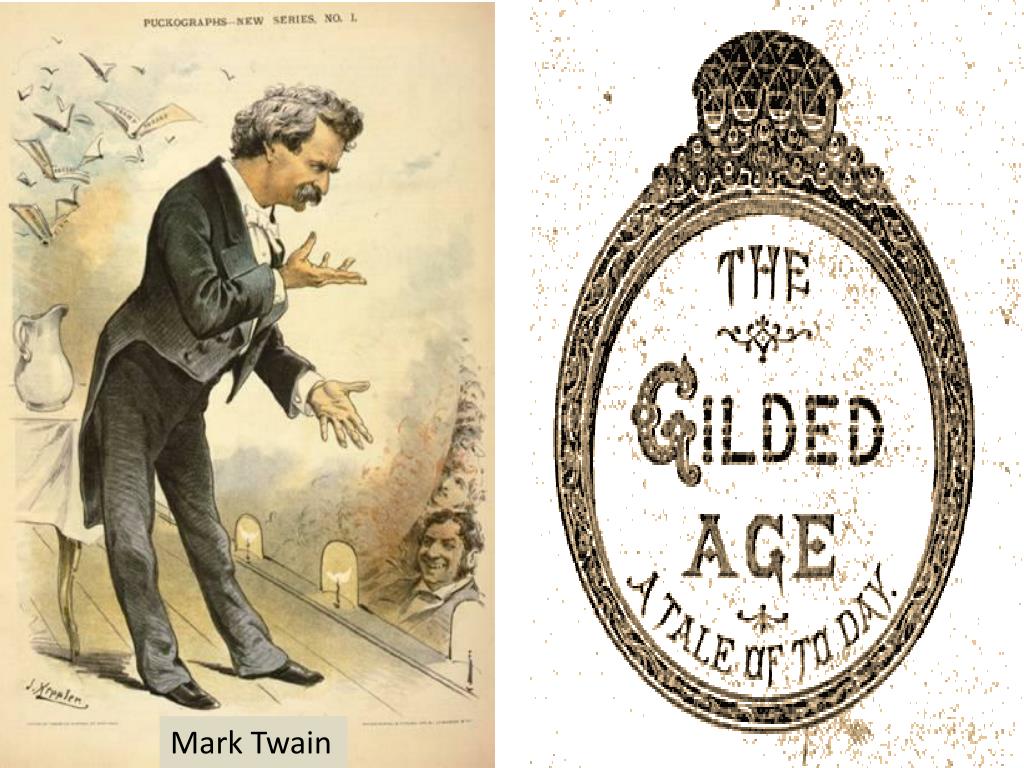
  1. Mark Twain

  2. The wealthy lived extravagant lifestyles and considered themselves elitists. The common people resented their snobbish attitudes and wealth. There was a caste system in the U.S. 1861---------3 millionaires----------1900--------3,800 1900, 90% of wealth, controlled by 10% of population

  3. The Role of the Political Boss • May serve as mayor; he: • controls city jobs, business licenses • influences courts, municipal agencies • arranges building projects, community services • Bosses paid by businesses, get voters’ loyalty, extend influence

  4. SocialDarwinism • A powerful idea of the Gilded • Era was Social Darwinism. • In 1859, Charles Darwin argued • that plant and animal life had • evolved over the years by a • process he called natural • selection. • Social Darwinists applied this • “survival of the fittest” idea • to human behavior. • Industrialists like John D. • Rockefeller heartily embraced • the theory. Rockefeller said • the growth of huge businesses • like his own Standard Oil was • “merely the working out of the • law of nature and the law of • God.”

  5. GospelofWealth • Andrew Carnegie advocated • a gentler version of Social • Darwinism that he called the • Gospel of Wealth. • This philosophy held that • wealthy Americans should • engage in philanthropy and • use their great fortunes to • create the conditions that • would help people help • themselves. Building schools • and hospitals, for example, • was better than giving • handouts to the poor. • Carnegie funded libraries all • across the nation.

  6. Fond of saying that "the man who dies rich dies disgraced," Carnegie then turned his attention to giving away his fortune. He abhorred charity, and instead put his money to use helping others help themselves. That was the reason he spent much of his collected fortune on establishing over 2,500 public libraries as well as supporting institutions of higher learning. By the time Carnegie's life was over, he gave away 350 million dollars. Andrew Carnegie