SlideServe
Menu
Préférences
© SlideServe · v2026

Research Proposal

brittanye avatar
12 diapositives · 617 Views · Jan 08, 2020

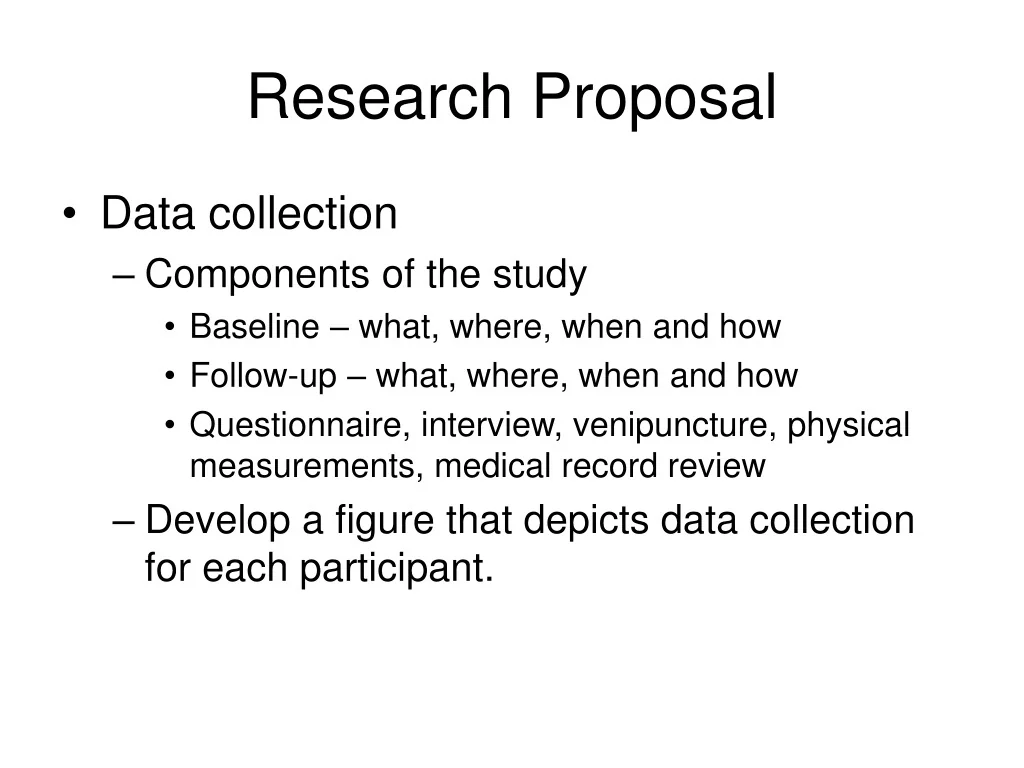
Research Proposal. Data collection Components of the study Baseline – what, where, when and how Follow-up – what, where, when and how Questionnaire, interview, venipuncture, physical measurements, medical record review Develop a figure that depicts data collection for each participant.
Research Proposal - slide 1
01 / 12Research Proposal
1 / 17

Télécharger la présentation

Research Proposal
Une image / un lien ci-dessous est fourni (tel quel) pour télécharger la présentation

Politique de téléchargement : le contenu du site vous est fourni TEL QUEL pour votre information et votre usage personnel ; il ne peut être vendu, concédé sous licence ni partagé sur d’autres sites sans l’accord de son auteur.Le contenu vous est fourni TEL QUEL, pour votre information et votre usage personnel uniquement. Téléchargez la présentation en cliquant sur ce lien. Lors du téléchargement, si vous ne parvenez pas à télécharger une présentation, l’éditeur a peut-être supprimé le fichier de son serveur.Pendant le téléchargement, si vous ne parvenez pas à obtenir une présentation, le fichier a peut-être été supprimé par l’éditeur.

F I N

Plus de contenu associé

Transcription de la présentation
  1. Research Proposal • Data collection • Components of the study • Baseline – what, where, when and how • Follow-up – what, where, when and how • Questionnaire, interview, venipuncture, physical measurements, medical record review • Develop a figure that depicts data collection for each participant.

  2. Surgery Liver Biopsy OR Enrollment (n=50) Bariatric Patients Pre-surgery Full Exam GCRC 4-week Post-OP Full Exam GCRC 12-month Post-OP Full Exam GCRC 3,6,9-month Post-OP Brief Exam GCRC Enroll 600 women Figure 3. Study Components Prenatal Examination GCRC Medical Record Abstraction Delivery Cord Blood Telephone Interview 2 week 3 month 6 month 9 month 6-week Examination GCRC Mother and Child Components 1-year Examination GCRC Mother and Child Components Figure 5.1. Components of the proposed study Research Proposal

  3. Research Proposal • Data collection • Main Exposure and Outcome Variables • Details on what will be collected for these variables • Questionnaires • Developed for this study? • Has it been validated? • Has it been validated in race/ethnic, age, gender? • What language will be used? • If you are studying acculturation how will it impact your study if questionnaires are only available in English • Scale or a score, need to provide information on the range of values, how it is scored and interpreted, what type of variable is the output (continuous, discrete, ordinal, nominal)

  4. Research Proposal • Data collection • Main Exposure and Outcome Variables • Details on what will be collected for these variables • Laboratory assays • Variation • How standardized are the measurements. • Are there different analytical techniques? • Does it matter which one you use? • Batch variation – is this a problem • Biologic variation – is this a problem • Upper and lower bounds • Reliability coefficient, same person different days, same sample different times • Where will the assays be completed. Will samples be stored and measured all at once or will they be sent as acquired.

  5. Research Proposal • Data collection • Main Exposure and Outcome Variables • Details on what will be collected for these variables • Standardized measurements • Blood pressure, ultrasound, MRI • Need a standardized protocol for how you will measure it • Clinical protocol is not good enough • Good starting spot • Need a standardized protocol for how you will read it • Clinical protocol is not good enough • May need repeatability studies for scanning/reading • Blinded

  6. Research Proposal • Data collection • What is the final information that will be obtained • DXA – percent body fat • MRI – visceral adiposity, amount of fat in kg • Carotid ultrasound – intima media thickness • The focus of your study – may be a lot of information available but what is central to your study.

  7. Research Proposal • Data collection • Main Exposure and Outcome Variables • Details on what will be collected for these variables • Case definitions • Define exposure, outcome or study population • Clinical definition – not ideal • Standard criteria • What information are needed to make the diagnosis • How will you get that information: Abstract medical record or measure required variables to obtain all required information • Develop algorithm to define disease - missing data

  8. Research Proposal • Data collection • Confounders -- covariates • Identify potential confounders • Comorbidities • Age, sex, race, SES • Observational study – these can make or break • Less information on measurement of these variables

  9. Research Proposal • Data analysis • For each hypothesis write out your exposure and outcome. • Indicate variable to be used in analysis for both the exposure and outcome. • Continuous, categorical, nominal or ordinal • Power calculation for that hypothesis

  10. Research Proposal • Theoretical model • Exposure  Outcome • Covariates – where do they enter in

  11. Microbiome Hepatocyte Metabolism Diet/ Physical Activity Incretin/Satiety Obesity ↕ Visceral Adiposity Insulin Resistance ↕ Impaired Insulin Secretion Diabetes Hepatic Steatosis Figure 4. Aim 1 Conceptual Framework; Proposed etiology of diabetes and hepatic steatosis in morbidly obese patients prior to gastric bypass surgery. Research Proposal

  12. Research Proposal • Problems, Pitfalls and limitations • Keep a running list of problems with your study