Conflict and Characterization in Jefferson and Grant: A Study of Oppression and Identity
This review probes the intricate dynamics of Jefferson Grant's conflicts within Louisiana's oppressive society. Exploring themes of racial struggle, personal identity, and the pursuit of truth against the establishment, the narrative examines Grant's role as a teacher and the societal norms of the plantation. Key discussions include the portrayal of white oppression, characterization of figures like Matthew Antoine, and the significance of literary devices such as simile and metaphor. This analysis invites a deeper understanding of Gaines' work, revealing the complexities of character and environment.

Conflict and Characterization in Jefferson and Grant: A Study of Oppression and Identity
E N D
Presentation Transcript
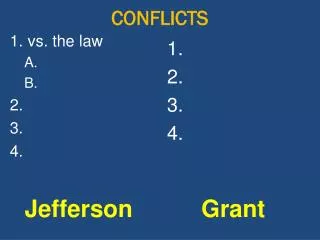
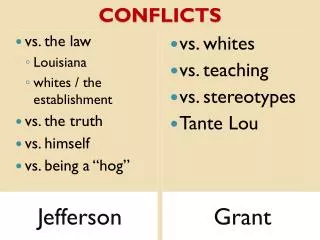
Jefferson Grant • vs. the law • Louisiana • whites / the establishment • vs. the truth • vs. himself • vs. being a “hog” • vs. whites • vs. teaching • vs. stereotypes • Tante Lou CONFLICTS
AP Literature and Composition December 6, 2011 Mr. Houghteling “It’s a Review-Time Tuesday!”
AGENDA • Review death penalty T-Charts. • Review pages 31-74. • Oral reading.
Grant as teacher (33-41) Ch. 5 • What did we learn about Grant as teacher of the plantation children? (Characterization) • What do we learn about the plantation society? (Setting)
Waiting for Sam Guidry (42-50) • What evidence can you cite about the tyranny of white oppression as demonstrated in Chapter 6?
Dr. Joseph (51-58) • Why does Ernest J. Gaines include the chapter of the superintendent of school visiting the plantation school? (Author’s purpose) • What comparison does Grant make about Dr. Joseph’s treatment of the children? Cite your evidence. (historical background)
The old men and Matthew Antoine (59-66) • What is the “vicious circle” Grant describes? (62) (historical background) • Who is Matthew Antoine, and why is he so important to Grant and, in extension, to our understanding of the novel? (Characterization)
The first visit with Jefferson (67-74) • How did you react to Gaines’s description of the visit between Miss Emma, Tante Lou, Grant, and Jefferson?
TRUST SKEPTICISM • What the character does, or how the character acts • Thoughts, feelings, emotions a character has • The physical description of the character • What the character says • What others say about the character • The direct comments the narrator says about the character or the character’s nature Methods of Characterization
HOMEWORK • Read and study through Chapter 10 (page 79). • Find and review Gaines’s use of literary devices: • SIMILE • METAPHOR • IMAGERY • Methods of CHARACTERIZATION