Download
1 / 4
40 likes | 158 Vues
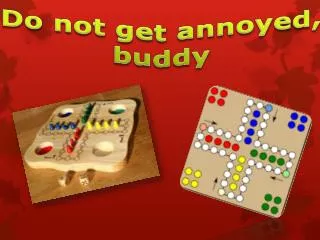
"Do Not Get Annoyed, Buddy" is a classic German board game created by Josef Friedrich Schmidt in 1907/1908 and officially released in 1914. This engaging cross and circle game, reminiscent of the Indian game Pachisi, accommodates 2 to 4 players, each controlling 4 pieces. Players take turns rolling a die to advance their pieces according to the number rolled, with the opportunity to bring pieces into play upon rolling a six. The objective is to be the first to move all pieces into the "home" row, using strategy to jump and send opposing pieces back.

E N D
- "Do not get annoyed, buddy"is a Germanboard game developed by Josef Friedrich Schmidt in 1907/1908. - The game was issued in 1914. - It is a cross and circle game, similar to the Indian game Pachis Cross and cirle game
Rules - The game can be played by 2, 3 or 4 players – one player per board side - Each player has 4 game pieces - The players throw a die in turn and can advance any of their pieces in the game by the thrown number of dots on the dice.
- Throwing a six means bringing a piece into the game and throwing the dice again. - Pieces can jump over other pieces, and throw out pieces from other players - The first player with all of his pieces in his "home" row wins the game.