Download
1 / 6
60 likes | 162 Vues
The U.S. generates 141 million tons of coal ash annually, containing hazardous pollutants like arsenic, mercury, and lead. Currently, there are no comprehensive federal regulations governing coal combustion residuals (CCR), and existing state laws are insufficient. This mismanagement has led to water contamination at 137 sites across 34 states, with serious public health risks for communities near unlined ash ponds. Options for regulation under RCRA include treating CCR as either hazardous or nonhazardous waste, establishing stricter management protocols to mitigate risks.

E N D
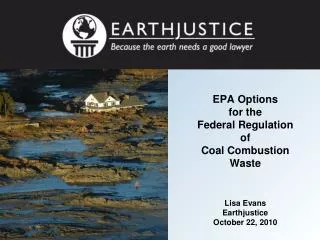
EPA Options for the Federal Regulation ofCoal Combustion WasteLisa EvansEarthjusticeOctober 22, 2010
The Problem • 141 million tons of coal ash generated annually in the U.S. • Hazardous pollutants (arsenic, mercury, lead, etc) captured by CAA pollution control devices are transferred to the solid waste (CCR). • No federal regulation of CCR. State laws are inadequate. • Water contamination via mismanagement documented at 137 sites in 34 states. • Toxic leaching of coal ash poses high risk. People living near some unlined ash ponds have 1 in 50 chance of cancer.
Options for CCR Regulation under RCRA • Subtitle C: Regulation as a “special waste” with “cradle to grave” management requirements, including phase-out of ash ponds. • Subtitle D: Regulation of CCR as a nonhazardous waste with self-implementing requirements allowing operation of lined ash ponds. • Subtitle D Prime: Same as Subtitle D, with allowance for continued operation of unlined coal ash ponds. • Subtitle C Prime: Regulation as a hazardous waste with tighter timelines and requirements for closure of both ash ponds and unlined landfills.