Download
1 / 13
130 likes | 231 Vues
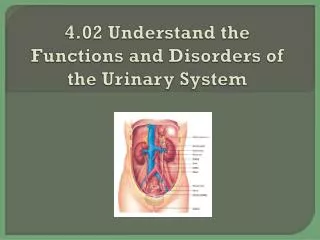
The urinary system plays a vital role in the body's homeostasis by excreting nitrogenous wastes and regulating water and salt balance. Urea, a byproduct of protein and nucleic acid metabolism, is filtered from the blood at the glomerulus within the nephron. The system excretes urine, which is stored in the urinary bladder and transported outside the body. Key processes include filtration, reabsorption of essential nutrients, and secretion of excess salts and wastes, maintaining proper composition and balance of bodily fluids.

E N D
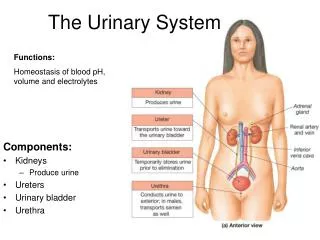
3 functions of the urinary system • Excrete nitrogenous wastes • Urea produced from the metabolism of proteins and nucleic acids • Other animals produce ammonia or uric acid • Regulate water balance • Regulate salt balance
Filters the blood Produces urine (contains urea) Regulates water and salt balance
Stores the urine. Has specialized expandable cells
Bowman’s capsule Proximal tubule Glomerulus Capillaries Artery Fig. 25-6d Artery Distal tubule From another nephron Branch of renal vein Collecting duct Loop of Henle with capillary network
Everything in the blood smaller than blood cells or large proteins is filtered into the nephron at the glomerulus/bowman’s capsule Salts are secreted into urine if their concentration in the blood is too high Vital materials -sugars -amino acids -water -NaCl Are reabsorbed into the blood, so they do not leave the body Urine is excreted from the body
Kidney tubule Kidney tubule 1 Bowman’s capsule H2O Nutrients H2O HCO3– NaCl HCO3– NaCl Blood K+ Some drugs and poisons H+ H+ 3 Fig. 25-8 Filtrate composition Collecting duct Cortex H2O NaCl HCO3– H+ Urea Glucose Amino acids Some drugs Medulla Loop of Henle 2 NaCl NaCl H2O Reabsorption Secretion Filtrate movement Urea NaCl H2O Urine (to renal pelvis)
Fig. 25-7 Filtration Reabsorption Secretion Excretion Nephron tubule Urine H2O, other small molecules Capillary Interstitial fluid