The Dred Scott Decision: Fairness and Political Ramifications in Pre-Civil War America
100 likes | 220 Vues
This lesson explores the Dred Scott decision's implications on slavery and citizenship rights in the United States. Students will analyze whether the ruling was fair for its time and study the political landscape leading to the Civil War, focusing on the presidential election of 1860 between Abraham Lincoln and Stephen Douglass. The discussion will address differing viewpoints on abolitionism, states' rights, and how these issues reflect the deep divisions in American society. Final thoughts will consider the potential consequences of Lincoln's victory for the nation.


The Dred Scott Decision: Fairness and Political Ramifications in Pre-Civil War America
E N D
Presentation Transcript
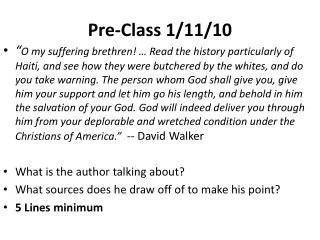
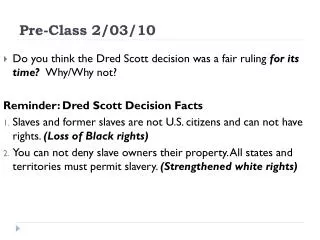
Pre-Class 2/03/10 • Do you think the Dred Scott decision was a fair ruling for its time? Why/Why not? Reminder: Dred Scott Decision Facts • Slaves and former slaves are not U.S. citizens and can not have rights. (Loss of Black rights) • You can not deny slave owners their property. All states and territories must permit slavery. (Strengthened white rights)
Welcome 2/03/10 Today’s Agenda: • Pre-Class • Share Outs • Audio Files • Lincoln vs. Douglass • Final Thoughts & HW Announcements: • Upcoming take-home essay assignment. (Given Tomorrow) Objectives: • To study the reactions to the Dred Scott decision. • To study the political opinions of the time.
Lincoln vs. Douglass • The presidential election of 1860 was one of the last issues that built towards civil war. • Why? • Abraham Lincoln (republican) • Represented Abolitionist voting base (strong in free states) • Stephen Douglass (democrat) • Represented slave owner/states rights interests (strong in slave states)
Pre-Class 2/04/10 • Abraham Lincoln is an abolitionist running for president in the 1860 presidential election. • Why would an abolitionist president be a problem in America at this time? • 3 lines please.
The truth about Lincoln • Fact #1 • Lincoln accepted that slavery was a part of American culture. • Fact #2 • Lincoln didn’t want to end slavery. He wanted it to stay in the south. • If contained in the south, slavery will die out over time • Fact #3 • Lincoln only changed his opinion on ending slavery at the end of the Civil War. • He was an abolitionist but also a politician…
Stephen Douglass • H • He saw slavery as a states’ rights issue. • Allow the states to choose, freedom or slavery • You cannot deny personal rights to white men.
How does Lincoln vs. Douglass embody the division of America’s people?Is this election a problem for the U.S.?
Lincoln vs. Douglass • Read the directions and complete the worksheet • Analyze what these two men argued about!
Final Thoughts • If either candidate has the support of ½ of the country, what happens to the U.S. when one of them (Lincoln) wins? • Finish the worksheet for HW