The Rise and Impact of Trading Kingdoms in West and East Africa
This overview explores the emergence of powerful kingdoms in West Africa, such as Ghana and Mali, fueled by the salt-gold trade across the Sahara. It examines how trade influenced the peoples of East Africa, leading to the development of bustling city-states like Kilwa and Mombasa. Cultural diffusion, particularly through the spread of Islam and languages such as Swahili, reshaped societies. The impact of prominent figures like Mansa Musa and explorers like Ibn Battuta is highlighted, illustrating the interconnectedness of African regions through commerce and cultural exchange.

The Rise and Impact of Trading Kingdoms in West and East Africa
E N D
Presentation Transcript
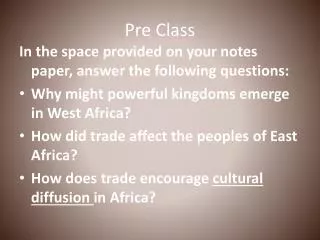
Pre Class In the space provided on your notes paper, answer the following questions: • Why might powerful kingdoms emerge in West Africa? • How did trade affect the peoples of East Africa? • How does trade encourage cultural diffusion in Africa?
The Salt-Gold Trade • Trade across the Sahara based on scarcity • N. Africa- salt • W. Africa – gold • Towns expanded to cities, and strong trading kingdoms in W. Africa
The Empire of Ghana • Ruler = “king of gold”; “ghana = war chief • Soninke – founders; controlled salt-gold trade, armed with iron tipped weapons
Welcomed Berbers (merchants from Northern edge of Sahara) who brought back gold to N. Africa • Became wealthy from TAXING and TRADE
The end of an empire Invasion and Fall of Ghana • 1076 – Berbers from the North captured Ghana, then split into smaller states • Mandingo farmers took advantage of weakness and est. empire of Mali
Mansa Musa, cntd. • Increased empire’s wealth by capturing salt mines) • Est. a SECURE empire • Adopted ISLAM – hajj to Mecca made Mali famous and increased contact between the Middle East, N. Africa and West Africa
Timbuktu • Crossroads of trade between Arabia, N. Africa and W. Africa • Salt, gold, and kola nuts passed through • Capital of the Mali Empire • MM built the Grand Mosque which attracted Muslim scholars • Intellectual and spiritual center of Africa
Rise of Songhai • Sunni Ali captured Gao (gaw) and Timbuktu • Askia Muhammad followed Islam – make Timbuktu center of learning • Moroccan soldiers overpowered Songhai warriors’ spears and arrows with guns and cannons
Benin • Forest kingdom near the Equator • Delta of the Niger River • Oral traditions preserved history • Benin City – center of industry • Woven goods, brass, wood, ivory, bronze
Trading Cities of East Africa • East African coast – good harbors produced small villages which grew into busy city-states • Askum, Kilwa, Mombasa, Sofala – busy marketplaces • Goods from the interior brought to the coast for trade – slaves, gold, ivory, animals skins • Monsoon winds carried goods to and from India
RESULT OF TRADE • Islam took root and cultural diffusion occurred (ie. Swahili - mixing African language with Arab words
Zimbabwe “stone dwelling” 10th century walls – 36 ft. high/20 ft. thick – Europeans didn’t believe Africans did this!
Ibn Battuta Where did Ibn Battuta travel? How did his travels differ from those of Marco Polo?