Download
1 / 14
140 likes | 254 Vues
This article explores the concepts of macroevolution and the diversity seen through microevolutionary mechanisms. It examines population groupings, species interbreeding, and the impacts of geographic isolation on evolution. Key aspects like reproductive isolation, both prezygotic and postzygotic, are discussed, highlighting how species remain distinct yet potentially overlapping. Evidence supporting evolution, such as fossil records, morphological features, and molecular comparisons, including DNA hybridization, is presented. Additionally, common ancestry is illustrated through embryological similarities.

E N D
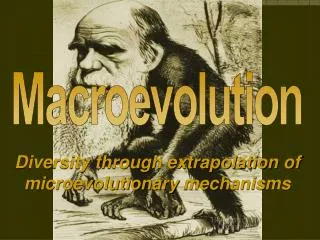
Macroevolution Diversity through extrapolation of microevolutionary mechanisms
Groupings • Population • Local group of orgs of one species
Groupings • Species • Populations of organisms that may interbreed to produce fertile offspring
Geographic Isolation Populations are physically separated
Geographic Isolation • Natural selection, mutations, and gene flow occur in these new populations independently of each other
Reproductive Isolation J F M A M J J A S O N D • Pops overlap, but are unable interbreed successfully • Prezygotic • Temporal • Behavioral • Incompatibility Mating Season for Group A Mating Season for Group B
Reproductive Isolation • Postzygotic • Dysfunction • Sterility
Evidence of Evolution • Fossil Record • Extant species are not the only ones to have existed on earth. • Some fossils may represent missing links between orgs with distant relations
Rates of Change Gradualism Punctuated Equilibrium
Evidence of Evolution • Morphology • Homologous structures indicate common ancestry
Evidence of Evolution • Morphology • Analogous structures are likely coincidental
Evidence of Evolution • Morphology • Vestigial structures are remnants of ancestors that have no apparent use in a current organism.
Evidence of evolution • Biochemistry • Molecular comparisons indicate relations (closer match = closer relation) • DNA Hybridization • Protein Comparison (amino acid sequence) A+B A B A B C
Evidence of evolution • Embryology • Similarity in early development indicates common ancestry