Understanding Sensorineural Deafness and Associated Lower Cranial Nerve Signs
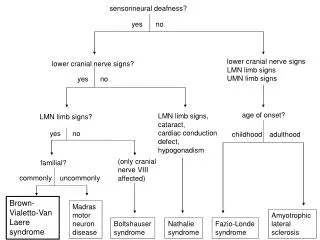
This article delves into the complexities of sensorineural deafness, focusing on lower cranial nerve signs and their association with various motor neuron diseases. It discusses the distinction between lower motor neuron (LMN) and upper motor neuron (UMN) limb signs and explores additional symptoms such as cataracts, cardiac conduction defects, and hypogonadism. The article also addresses different syndromes linked to sensorineural deafness, including Brown-Vialetto-Van Laere syndrome, Madras motor neuron disease, and more, alongside their age of onset and familial patterns.

Understanding Sensorineural Deafness and Associated Lower Cranial Nerve Signs
E N D
Presentation Transcript
sensorineural deafness? yes no lower cranial nerve signs LMN limb signs UMN limb signs lower cranial nerve signs? yes no age of onset? LMN limb signs, cataract, cardiac conduction defect, hypogonadism LMN limb signs? yes no childhood adulthood (only cranial nerve VIII affected) familial? uncommonly commonly Brown-Vialetto-Van Laere syndrome Madras motor neuron disease Amyotrophic lateral sclerosis Boltshauser syndrome Nathalie syndrome Fazio-Londe syndrome