Analyzing Forum Designations: Public vs. Non-Public Spaces for Expressive Activities
40 likes | 157 Vues
This analysis explores the distinctions between public and non-public forums in the context of expressive activities in airports, parks, and national monuments. It examines the opinions of Justices Rehnquist, Kennedy, and others regarding restrictions on solicitation and leafleting, highlighting the implications of their rulings. Key considerations include the physical characteristics of properties, government intentions, and reasonable restrictions. The discourse raises questions about free speech zones and the traditional uses of public spaces, urging a reassessment of forum designations.


Analyzing Forum Designations: Public vs. Non-Public Spaces for Expressive Activities
E N D
Presentation Transcript
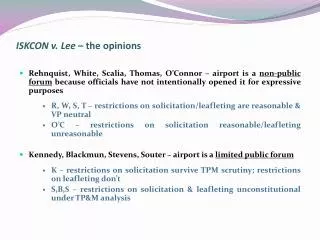
ISKCON v. Lee – the opinions • Rehnquist, White, Scalia, Thomas, O’Connor – airport is a non-public forum because officials have not intentionally opened it for expressive purposes • R, W, S, T – restrictions on solicitation/leafleting are reasonable & VP neutral • O’C – restrictions on solicitation reasonable/leafleting unreasonable • Kennedy, Blackmun, Stevens, Souter – airport is a limited public forum • K – restrictions on solicitation survive TPM scrutiny; restrictions on leafleting don’t • S,B,S – restrictions on solicitation & leafleting unconstitutional under TP&M analysis
Rehnquist vs. Kennedy and forum issues • Rehnquist: airport is a non-public forum. Not a limited public forum because government did not intentionally open it for purposes of public discourse. • Issue: If others are allowed in for a variety of purposes why shouldn’t we say speech should be included. Why is there an extra burden on speakers to show INTENT to open to them? • Justice Kennedy took a different approach: If the objective, physical characteristics of the property & the actual public access/uses permitted by the government indicate that expressive activity would be appropriate and compatible with those uses, the property is a designated public forum. Most important considerations are: • Does property share physical similarities w/ more traditional public forums; • Has government permitted/acquiesced in broad public access to the property; • Would expressive activity (in general) tend to interfere in a significant way with the uses to which the government has actually dedicated the property • Are reasonable time, place, and manner restrictions available as an alternative to wholesale bans on access • What are the advantages or implications of Kennedy’s approach?
Back to the traditional public forum – is it always what it seems? • After Kokinda/Summum (p. 200) – is SCT signaling that a traditional public forum isn’t always a traditional public forum? Under what circumstances would/should that be the case? • Kokinda:when sidewalk isn’t really used as a public passageway • Summum:when the speech isn’t a typical transitory protest/entertainment that doesn’t interfere with the other traditional function of the property (driving, walking, park) – unlike a permanent monument • Should a park be a different forum for different kinds of speech? Dangers?
Comparing parks • Are national parks (Boardley) different from municipal parks so that the former should be deemed as non-public fora? Why? • Does Boardley’s reasoning re what makes a public forum concern you? • Are “free speech zones” within national parks (or traditional public fora) a reasonable alternative to free access to the park/traditional forum? • What about national monuments as in Oberwetter? They are often outdoors and run by NPS and have been the sites of important rallies and protests. • Are they more akin to traditional or non-public forum? • Is public protest or public expression necessarily inconsistent with the purpose of a monument? Does the decision’s reasoning suggest reason for concern?