Download
1 / 4
40 likes | 148 Vues
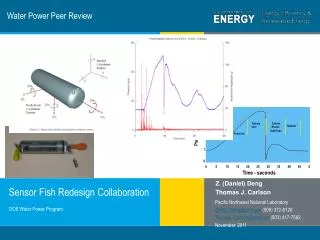
This project aims to redesign a sensor fish device to monitor water passageways in hydroturbines for optimized power production and fish safety. Objectives include developing design specifications, building prototypes, and integrating with a commercial vendor. The technical approach involves collaboration with users, laboratory and field testing, and cost-effective deployment. The schedule spans from January 2012 to September 2013 with milestones in application space definition, design specification finalization, and prototype build completion.

E N D
Water Power Peer Review Z. (Daniel) Deng Thomas J. Carlson Pacific Northwest National Laboratory Zhiqun.Deng@pnnl.gov (509) 372-6120 Thomas. Carlson@pnnl.gov (503) 417-7562 November, 2011 DOE Water Power Program Sensor Fish Redesign Collaboration
Purpose, Objectives, & Integration • Project Purpose • Redesign a proven device to address current needs to observe conditions in the water passageways of hydroturbines that affect power production performance and fish passage safety • Objectives • Identify measurement applications identified by turbine designers, power production entities, research institutes, and regulators • Develop design specifications that address application needs • Build and test prototypes in the laboratory and at operating power production facilities • Integration • Place the sensor fish a commercial vendor that can build the sensor and support its use by others
Technical Approach • Work with potential users to identify requirements for application • Design to meet application requirements • Perform both laboratory and full scale field tests of prototypes • Implement an innovative design to reduce deployment and recovery complexities and costs • Place the new Sensor Fish with a commercial vendor capable of building the sensor at a competitive cost and supporting its users
Plan, Schedule, & Budget Schedule • Initiation: January 2012 • Completion: September 2013 • FY12 Milestones • Q2: Application Space Definition • Q3: Design Specification Finalization, Prototype Build Initiation • Q4: Complete Prototype Build, Initiate Laboratory Testing Budget • DOE Funding $300K • Partner Funding $50K • Partner In-Kind Contributions of Labor and Support for Field Testing