Download
1 / 10
100 likes | 248 Vues
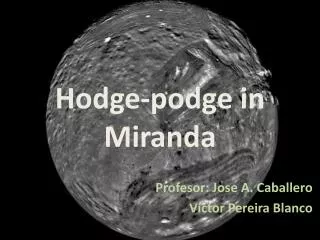
Miranda, one of Uranus' moons, presents an astonishing "hodgepodge" surface that captures the attention of planetary scientists. Discovered by Gerard Kuiper in 1948 and closely imaged by Voyager 2 in 1986, Miranda features a mix of geological characteristics such as cliffs, ridges, and grooves. The notable "Verona Rupes" cliff stands as the solar system's tallest, rising between 10-20 km. The surface's patchwork is attributed to past geological activity, potentially resulting from icy collisions that created a unique internal structure and subsequent geological processes.

E N D
Hodge-podge in Miranda Profesor: Jose A. Caballero Víctor Pereira Blanco
Index • General properties and description • Miranda´s surface: hodge-podge • Theories
Miranda´ssurface:hodge-podge Theories General properties and description Miranda: Uranus V Discoveredby Gerard Kuiper in 1948 Voyager 2 in 1986
Miranda´ssurface:hodge-podge Theories General properties and description Craters, coronae, ridges, grooves, cliffs…. • A patchwork of regions Voyager 2 image of Miranda taken shortly before closest approach. January 24, 1986. Range, 21,000 miles.
Miranda´ssurface:hodge-podge Theories General properties and description This cliff is called "Verona Rupees" and is the deepest of any known cliff in the solar system, between 10-20 KM high! January 24, 1986. Range, 22,000 miles. Photo Credit NASA.
Miranda´ssurface:hodge-podge Theories General properties and description Along the edge of Miranda's face, a wide band of ridges and grooves cut across the surface like a racetrack January 24, 1986. Photo Credit NASA
Miranda´ssurface:hodge-podge Theories General properties and description Chevron A series of lighter and darkercoloursarranged in a V shape January 24, 1986. Photo Credit NASA
Miranda´ssurface:hodge-podge Theories General properties and description • It was predicted that Miranda would be too small to show any signs of geological activity... • A collision broke it into icy and rocky pieces that then fell back together: denser rocky to the centre and ice remain in the surface. This friction would have warm the icy interior an created currents like a boiling soup. Currents would have compressed the crust.
Miranda´ssurface:hodge-podge Theories General properties and description • Diapirs: something rising up from below, in this case, warm ice. a type of intrusion in which a more mobile and ductily-deformable material is forced into brittle overlying rocks Destruction and re-assembly no longer necessary Heat needed for explaining the shape of the surface: resonance in the past. And then...nothing. Work unfinished.
References: NASA´s Solar SystemExplorationsite. Views of the Solar System: Mirnda, a Moon of Uranus. Surface of Miranda: Identification of WaterIceHamilton Brown, R., Clark, R.N 1984Icar...58..288B Crateringhistory of Miranda: Implicationsforgeologicprocesses. Plescia, J.B. 1988Icar...73..442P Fin Thank you for your attention