An Introduction to Human Anatomy: Understanding Body Structure and Terminology
230 likes | 322 Vues
This informative guide introduces the science of human anatomy, encompassing the structure and subdivisions such as cadaveric/gross anatomy, living anatomy, neuroanatomy, and more. It details the anatomical position of the body, different planes of anatomy, terminologies like anterior, posterior, proximal, and distal, and movements at various joints. With clear illustrations and explanations, this resource is essential for anyone studying anatomy.


An Introduction to Human Anatomy: Understanding Body Structure and Terminology
E N D
Presentation Transcript
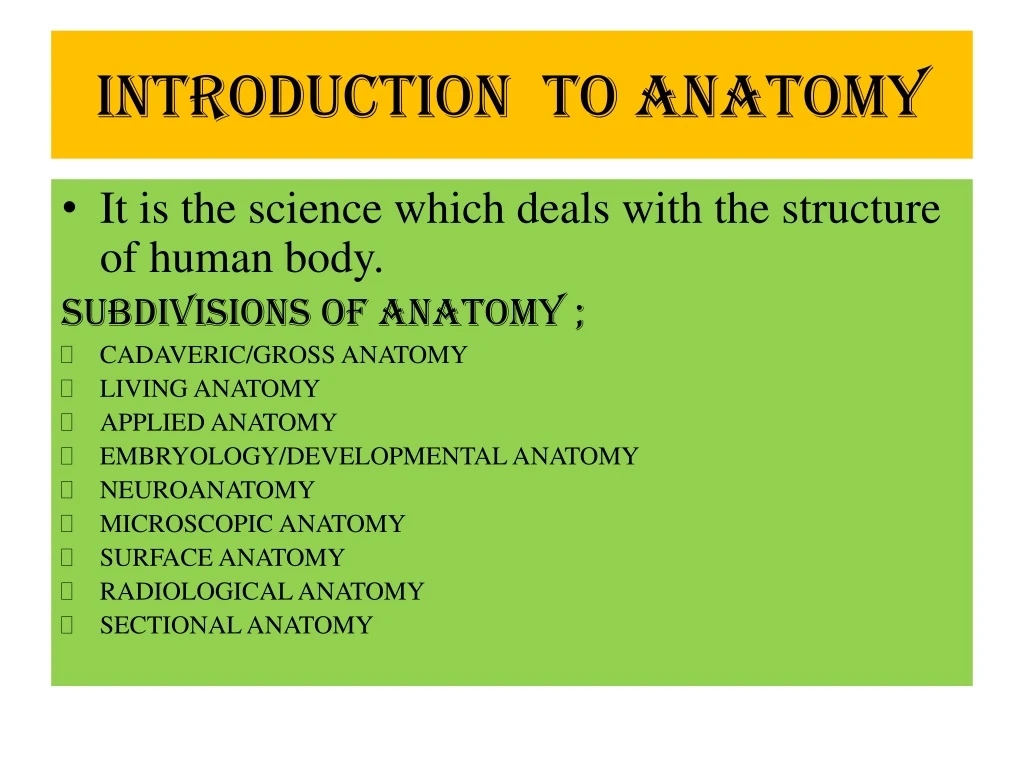
Introduction to Anatomy • It is the science which deals with the structure of human body. SUBDIVISIONS OF ANATOMY ; • CADAVERIC/GROSS ANATOMY • LIVING ANATOMY • APPLIED ANATOMY • EMBRYOLOGY/DEVELOPMENTAL ANATOMY • NEUROANATOMY • MICROSCOPIC ANATOMY • SURFACE ANATOMY • RADIOLOGICAL ANATOMY • SECTIONAL ANATOMY
What is anatomical position of the body? • The body is standing upright. • With the upper limbs hanging by the sides • And the palms of the hands directed forwards. • With head, eyes and toes directed forwards. • And the lower limbs are parallel with the toes pointing forwards.
What are the different Planes ? Median Plane : It is an imaginary plane that divides the body into two apparently equal halves, right and left. Sagital Plane : It is the plane parallel to median plane. Coronal Plane : It is a vertical plane at right angles to median plane. Transverse Plane : It is a Horizontal plane which cuts the body into upper and lower parts.
What is Anterior and Posterior ? Anterior means nearer the front of the body. Posterior means nearer the back of the body. In the trunk, instead of anterior and posterior ventral and dorsal can be used. ( Palmar & Plantar )
What is proximal and distal ? • It describe the relative distance from the roots of the limbs. • eg: Proximal phalanx, Distal phalanx etc.
Some of the other terminologies. • Superficial • Internal • Superior • Supine • Medial • Deep • External • Inferior • Prone • Lateral
Joint. • The site where two or more bones come together is known as a joint.
Terms used for movements. • Flexion • Abduction • Medial rotation • Pronation • Protraction • Extension • Adduction • Lateral rotation • Supination • Retraction
Flexion & extension. • These movements takes place in Sagittal plane. • In this diagram elbow joint is shown.
Abduction & adduction. • This movements takes place is coronal plane.
Rotation. • This movement is around the axis. • Medial &lateral rotation.
Pronation & supination. • Movements of fore arm.
Circumduction. • Combinations of all the movements. • Opposition movement*.
Inversion & eversion. • Movements of foot so that the sole faces in a medial or lateral direction.
Protraction & retraction. • Movements of temperomandibular joint or jaw.