
SlideServe
Menu
Préférences
© SlideServe · v2026

Understanding Natural Language

brygid avatar
20 diapositives · 446 Views · Sep 05, 2014

14. 14.0 The Natural Language Understanding Problem 14.1 Deconstructing Language: A Symbolic Analysis 14.2 Syntax 14.3 Syntax and Knowledge with ATN parsers. 14.4 Stochastic Tools for Language Analysis 14.5 Natural Language Applications 14.6 Epilogue and References
Understanding Natural Language - slide 1
01 / 20Understanding Natural Language
1 / 17

Télécharger la présentation

Understanding Natural Language
Une image / un lien ci-dessous est fourni (tel quel) pour télécharger la présentation

Politique de téléchargement : le contenu du site vous est fourni TEL QUEL pour votre information et votre usage personnel ; il ne peut être vendu, concédé sous licence ni partagé sur d’autres sites sans l’accord de son auteur.Le contenu vous est fourni TEL QUEL, pour votre information et votre usage personnel uniquement. Téléchargez la présentation en cliquant sur ce lien. Lors du téléchargement, si vous ne parvenez pas à télécharger une présentation, l’éditeur a peut-être supprimé le fichier de son serveur.Pendant le téléchargement, si vous ne parvenez pas à obtenir une présentation, le fichier a peut-être été supprimé par l’éditeur.

F I N

Plus de contenu associé

Transcription de la présentation
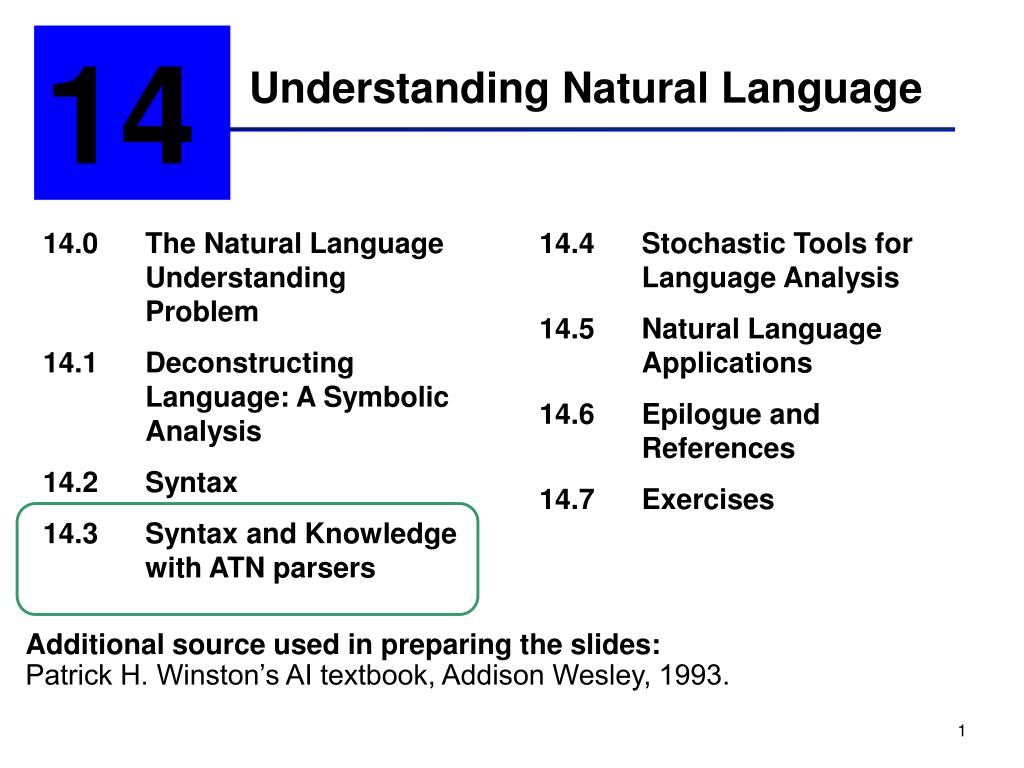
  1. 14 14.0 The Natural Language Understanding Problem 14.1 Deconstructing Language: A Symbolic Analysis 14.2 Syntax 14.3 Syntax and Knowledge with ATN parsers 14.4 Stochastic Tools for Language Analysis 14.5 Natural Language Applications 14.6 Epilogue and References 14.7 Exercises Understanding Natural Language Additional source used in preparing the slides: Patrick H. Winston’s AI textbook, Addison Wesley, 1993.

  2. Alternative to CSGs • Retain simple structure of CFGs • Augment them with procedures that perform the necessary contextual tests • Attach features to terminals and nonterminals:augmented transition networks

  3. Parsing with ATNs • Attach procedures to the arcs of the network. • The parser will execute those procedures while traversing the arcs. • The procedures: • Perform tests • Construct a parse tree • Both terminals and nonterminals are represented as identifiers with attached features.

  4. Frames for three nonterminals

  5. Dictionary entries - 1 like likes bite bites

  6. Dictionary entries - 2 men man dogs dog

  7. Dictionary entries - 3 a the

  8. Sentence function sentence-1; begin NOUN_PHRASE := structure returned by noun_phrase network; SENTENCE.SUBJECT := NOUN_PHRASE; end. noun_phrase verb_phrase init final 1 2

  9. Sentence function sentence-2; begin VERB_PHRASE := structure returned by verb_phrase network; if NOUN_PHRASE.NUMBER = VERB_PHRASE.number then begin SENTENCE.VERB_PHRASE := VERB_PHRASE; return SENTENCE end else fail end. noun_phrase verb_phrase init final 1 2

  10. Noun_phrase article noun function noun_phrase-1; begin ARTICLE := definition frame for next word of input; if ARTICLE.PART_OF_SPEECH = article then NOUN_PHRASE.DETERMINER := ARTICLE else fail end. init final 1 2 noun 3

  11. Noun_phrase article noun function noun_phrase-2; begin NOUN := definition frame for next word of input; if NOUN.PART_OF_SPEECH = noun and NOUN.NUMBER agrees with NOUN_PHRASE.DETERMINER.NUMBER then begin NOUN_PHRASE.NOUN := NOUN NOUN_PHRASE.NUMBER := NOUN.NUMBER return NOUN_PHRASE end else fail end. init final 1 2 noun 3

  12. Noun_phrase article noun function noun_phrase-3; begin NOUN := definition frame for next word of input; if NOUN.PART_OF_SPEECH = noun then begin NOUN_PHRASE.DETERMINER := unspecified NOUN_PHRASE.NOUN := NOUN NOUN_PHRASE.NUMBER := NOUN.NUMBER end else fail end. init final 1 2 noun 3

  13. Verb_phrase verb noun_phrase function verb_phrase-1; begin VERB := definition frame for next word of input; if VERB.PART_OF_SPEECH = verb then begin VERB_PHRASE.VERB := VERB; VERB_PHRASE.NUMBER := VERB.NUMBER end; end. init final 1 2 verb 3

  14. Verb_phrase verb noun_phrase function verb_phrase-2; begin NOUN_PHRASE := structure returned by noun_phrase network; VERB.PHRASE.OBJECT := NOUN_PHRASE; return VERB_PHRASE end. init final 1 2 verb 3

  15. Verb_phrase verb noun_phrase function verb_phrase-3; begin VERB := definition frame for next word of input; if VERB.PART_OF_SPEECH = verb then begin VERB_PHRASE.VERB := VERB; VERB_PHRASE.NUMBER := VERB.NUMBER VERB_PHRASE.OBJECT := unspecified; return VERB_PHRASE end; end. init final 1 2 verb 3

  16. “The dog likes a man.”

  17. Knowledge base for the “dogs world.”

  18. Case frames for two verbs

  19. Semantic representation

  20. Concluding remarks • The parse tree can be converted to a conceptual graph that represents the meaning of the sentence. • Simpler approaches use templates and plug in words as they are recognized. • Applications include: • Story understanding and question answering • Front End to a database • Information extraction and summarization on the web