
SlideServe
Menu
Préférences
© SlideServe · v2026

Structuralism

buch avatar
6 diapositives · 1K Views · Oct 20, 2019

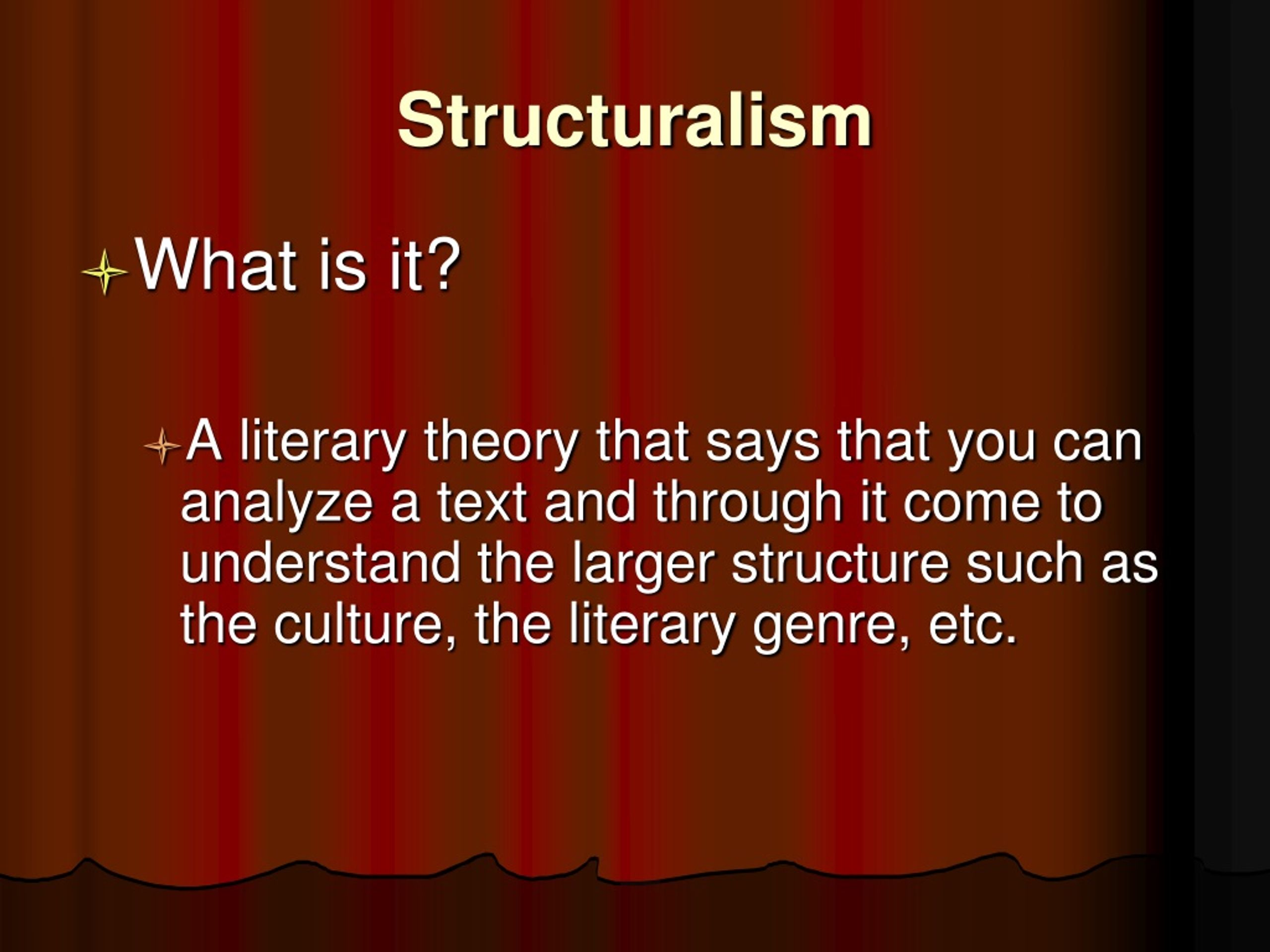
Structuralism. What is it? A literary theory that says that you can analyze a text and through it come to understand the larger structure such as the culture, the literary genre, etc. Structuralists say that everything exists as a part of a larger whole. Nothing can truly exist on its own.
Structuralism - slide 1
1 / 6

Télécharger la présentation

Structuralism
Une image / un lien ci-dessous est fourni (tel quel) pour télécharger la présentation

Politique de téléchargement : le contenu du site vous est fourni TEL QUEL pour votre information et votre usage personnel ; il ne peut être vendu, concédé sous licence ni partagé sur d’autres sites sans l’accord de son auteur.Le contenu vous est fourni TEL QUEL, pour votre information et votre usage personnel uniquement. Téléchargez la présentation en cliquant sur ce lien. Lors du téléchargement, si vous ne parvenez pas à télécharger une présentation, l’éditeur a peut-être supprimé le fichier de son serveur.Pendant le téléchargement, si vous ne parvenez pas à obtenir une présentation, le fichier a peut-être été supprimé par l’éditeur.

F I N

Plus de contenu associé

Transcription de la présentation
  1. Structuralism • What is it? • A literary theory that says that you can analyze a text and through it come to understand the larger structure such as the culture, the literary genre, etc.

  2. Structuralists say that everything exists as a part of a larger whole. Nothing can truly exist on its own.

  3. The French terms “langue” and “parole” are used in discussion of this theory. • “Langue”, refers to the system or structure, the whole. • “Parole”, refers to the individual utterance or example within the langue. • Therefore, a simple utterance, a play, a dance, a ceremony, etc., can be better understood once one understands the langue under which that parole is acting.

  4. What does this mean for us? • What are examples in our culture of “paroles” that help us understand the greater “langue” of our modern American culture? • Film industry • Schedules, how we spend our time • What we spend our money on • Advertisements

  5. Connection • Turn to your neighbor; using the general theme of “Medieval Theatre” together decide on a langue of that time period. • Then choose 2-3 paroles within that langue. • Share your results with another partnership.

  6. So what? • Why would a study or basic understanding of Stucturalism be of use in this unit - how can we use it to better understand Spanish Golden Age theatre?