Cell Transport
140 likes | 252 Vues
This overview explores passive and active transport mechanisms in cells, highlighting key concepts such as diffusion, osmosis, and tonicity. Passive transport involves the movement of particles from high to low concentration without energy expenditure, exemplified by the diffusion of sugar in iced tea or perfume. In contrast, active transport moves particles against their concentration gradient, requiring energy. This includes processes like endocytosis and exocytosis. The implications of hypotonic, hypertonic, and isotonic solutions on plant and animal cells are also discussed, providing a comprehensive understanding of cellular transport.


Cell Transport
E N D
Presentation Transcript
(1) Passive Transport/Diffusion
Passive Transport/Diffusion • The movement of particles from HIGH concentration to LOW concentration. Diffusion example
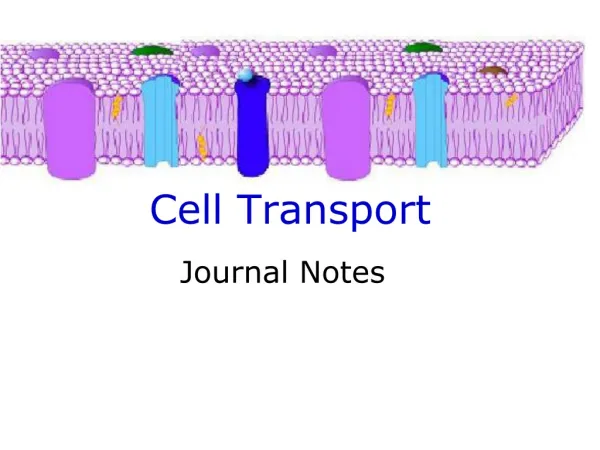
Passive Transport • Does NOT use energy. • May go through cell membrane or protein “doorways” in the cell membrane.
Example: Spraying Perfume Example: Sugar in Iced Tea
Passive Transport • The molecules move from an area of high concentration to an area of low concentration • Movement does not require energy (passive transport) • The movement of larger molecules (like sugar molecules) uses a protein “doorway” to go through the membrane
Passive Transport/Osmosis: The diffusion of waterOsmosis in a Cell
(2) Active Transport
(2) Active Transport • The movement of particles from LOW concentration to HIGH concentration.
DOES use energy. • May go through proteins in the cell membrane.
Bulk Transport-Active • Endocytosis- the cell membrane folds into a pouch (vesicle) that encloses the large particles
Bulk Transport-Active • Exocytosis- the release of cell products and wastes from the cell
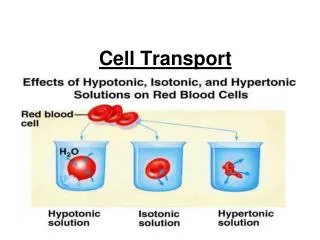
Tonicity (descriptive words used to compare solutions)Water will diffuse to where there is more solute. • Hypotonic Solution - One solution has a lower concentration of solute than another. • Hypertonic Solution - one solution has a higher concentration of solute than another. • Isotonic Solution - both solutions have same concentrations of solute.