Cell Transport
This guide explores key concepts of cell transport, focusing on diffusion, osmosis, and facilitated diffusion. It describes how particles move from areas of high concentration to low concentration, emphasizing that diffusion does not require energy. The text covers factors affecting the rate of diffusion, including particle size and temperature, as well as the role of transport proteins in facilitated diffusion. Additionally, the process of osmosis—water movement across a semi-permeable membrane—is explained, highlighting its importance in maintaining cell stability and function.


Cell Transport
E N D
Presentation Transcript
Diffusion • Random movement of liquid/gas particles from an area with ________________ to an area of ____________________.
Concentration Gradient • High to low.
Concentration Gradient • High to low. • The greater the difference in concentration – the faster the rate of diffusion.
Concentration Gradient • High to low. • The greater the difference in concentration – the faster the rate of diffusion. • Diffusion DOES NOT REQUIRE ENERGY.
Concentration Gradient • High to low. • The greater the difference in concentration – the faster the rate of diffusion. • Diffusion DOES NOT REQUIRE ENERGY. • Small particles diffuse faster than large – EG. The smell of ammonia diffuses more rapidly than onion smell.
Diffusion • Concentration Gradient = High to low. • The greater the difference in concentration – the faster the rate of diffusion. • Diffusion DOES NOT REQUIRE ENERGY. • Small particles diffuse faster than large – EG. The smell of ammonia diffuses more rapidly than onion smell. • Food & O2 diffuse into cells, and waste diffuses out. (EG. CO2)
Rate of Diffusion • Depends on temperature of liquid or gas.
Rate of Diffusion • Depends on temperature of liquid or gas. • The state of the matter being diffused (either liquid or gas).
Rate of Diffusion • Depends on temperature of liquid or gas. • The state of the matter being diffused (either liquid or gas). • The concentration on chemicals. YOU ALREADY KNOW THIS THOUGH RIGHT!
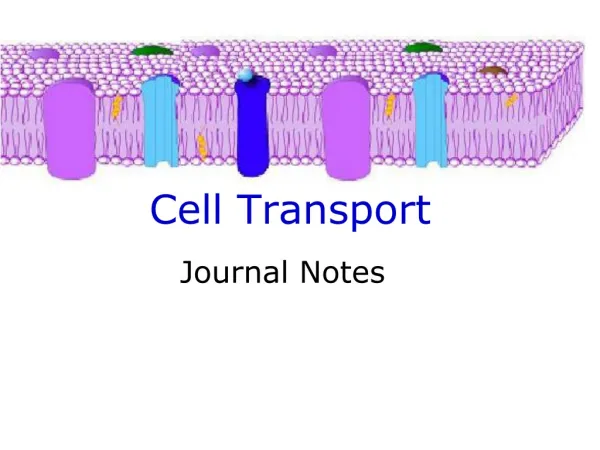
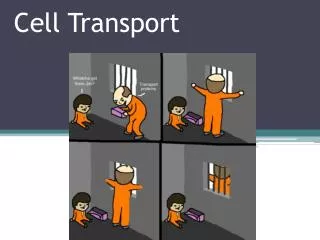
Facilitated diffusion • Cell membrane can contain transport proteins (elevators!). • This allows certain chemicals across a membrane faster than others.
Facilitated diffusion • Cell membrane can contain transport proteins (elevators!). • This allows certain chemicals across a membrane faster than others. • Water can diffuse easily, but glucose needs help – proteins are there to move it across the membrane.
Facilitated Diffusion • http://www.youtube.com/watch?v=JShwXBWGMyY&feature=fvsr
Osmosis – diffusion of water molecules across a partially permeable membrane from higher to lower concentration of water molecules.
Osmosis – diffusion of water molecules across a partially permeable membrane from higher to lower concentration of water molecules. • Direction of net movement can be predicted on the basis of relative concentrations of water and solute molecules in the solutions involved.
Osmosis – diffusion of water molecules across a partially permeable membrane from higher to lower concentration of water molecules. • Direction of net movement can be predicted on the basis of relative concentrations of water and solute molecules in the solutions involved. • When cells are placed in an environment of different concentration, there is an osmotic gradient between the external/internal environments. Cytoplasm is a solute.
Osmosis – diffusion of water molecules across a partially permeable membrane from higher to lower concentration of water molecules. • Direction of net movement can be predicted on the basis of relative concentrations of water and solute molecules in the solutions involved. • When cells are placed in an environment of different concentration, there is an osmotic gradient between the external/internal environments. Cytoplasm is a solute. • Hypotonic – High concentration of water, low concentration of solute.
Osmosis – diffusion of water molecules across a partially permeable membrane from higher to lower concentration of water molecules. • Direction of net movement can be predicted on the basis of relative concentrations of water and solute molecules in the solutions involved. • When cells are placed in an environment of different concentration, there is an osmotic gradient between the external/internal environments. Cytoplasm is a solute. • Hypotonic – High concentration of water, low concentration of solute. • Hypertonic – Low concentration of water, high concentration of solute.
Osmosis • http://www.youtube.com/watch?v=sdiJtDRJQEc
Osmoregulation – in plants • Remember there is a large vacuole in plants.
Osmoregulation – in plants • Remember there is a large vacuole in plants. • If this loses water, the cells become floppy and the cytoplasm pulls away from the cell wall.
Osmoregulation – in plants • Remember there is a large vacuole in plants. • If this loses water, the cells become floppy and the cytoplasm pulls away from the cell wall =
Osmoregulation – in plants • Remember there is a large vacuole in plants. • If this loses water, the cells become floppy and the cytoplasm pulls away from the cell wall = the plant will wilt.
Osmoregulation – in plants • Remember there is a large vacuole in plants. • If this loses water, the cells become floppy and the cytoplasm pulls away from the cell wall = the plant will wilt. • Vacuoles can become swollen, but cells bursting is prevented by the cell wall.
Osmoregulation – in animals • Because animal cells have no cell wall – they can burst if too much water goes into them.
Osmoregulation – in animals • Because animal cells have no cell wall – they can burst if too much water goes into them. • If water moves out they shrivel.
Osmoregulation – in animals • Because animal cells have no cell wall – they can burst if too much water goes into them. • If water moves out they shrivel. • It is very important that our blood system, kidneys, and liver keeps our cells in correct balance.
Osmoregulation – in animals • Because animal cells have no cell wall – they can burst if too much water goes into them. • If water moves out they shrivel. • It is very important that our blood system, kidneys, and liver keeps our cells in correct balance. • Uni-cells have _________________________ to get rid of excess water.
Osmoregulation Example. • Freshwater fish are in danger because there is a lot of water going into their bodies through osmosis – they get rid of this by peeing A LOT. • Saltwater fish – Excrete salt from special glands in their gills.