The Interconnection of Coffee Conservation and the Environmental Crisis
The ongoing coffee crisis highlights the urgent need for conservation within the Meson-American hotspot, where biodiversity is rapidly diminishing. With 50% of forests lost and coral reefs at risk, the agricultural practices related to coffee cultivation are significantly affecting ecosystems. This session explores the role of organic farming, private reserves, and agroforestry in mitigating environmental impacts. Key actions include restoring degraded land, diversifying crops, and strengthening protected areas. Collaborative efforts with private sector producers and international organizations are essential for sustainable solutions and environmental recovery.

The Interconnection of Coffee Conservation and the Environmental Crisis
E N D
Presentation Transcript
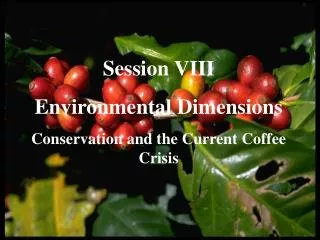
Session VIII Environmental Dimensions Conservation and the Current Coffee Crisis
Biodiversity • We are consuming the natural habitats that support life • Forests: 50% gone • Coral reefs: 60% at risk • Consumers are concerned • Loss of rain forests a “serious problem”, rating higher than any other environmental issue
Meson-American Hotspot • 1,026,117 km2 • 24,000 plants (5000 endemic) • 2,859 vertebrates (1,159 endemics)
Meson-American Hotspot • Only 20% original vegetation remains • 400,000 hectares lost each year • 50 hectares per hour
Coffee and Environment • Organic waste • Aquatic ecosystems • Impacts coffee quality
Coffee and Conservation • Habitat provided by fields • Habitat provided by farms • Habitat provided by adjacent forest
Coffee Crisis and Conservation • Loss of field diversity • Loss of forest on farms • Loss of adjacent forest
Conservation Actions Private Reserves • Short-Term Impact • Declare new parks and reserves • Strengthen protected areas • Purchase farms adjacent to protected areas • Concessions and private reserves Agroforestry Reforestation
Conservation Actions • Long-Term • Restoration of degraded lands • Diversification of coffee fields • Replant traditional varieties • Develop environmental services (water, carbon)
Conservation and Alliance Partners • GEF (World Bank, UNDP, UNEP) • IDB (Environment Programs, Multilateral Investment Fund) • International Conservation Organizations (WWF, TNC, CI etc.) • Private Foundations and Other Interested Donors
New Solutions Private Sector Producer Partners • Purchasing guidelines • Relationship coffees • Industry Standards
Solutions Credit and Financial Mechanisms • Financing with ecological returns • Reduce financing costs to increase profits • (example: IFC/GEF Credit Fund)
Parting Thoughts • Trade-offs • Not Good vs. Bad • Real Costs • Who and how to pay • When will we pay