Download
1 / 22
220 likes | 348 Vues
The CDC has recognized transgender women (TW) as a high-risk group for HIV, influenced by stigma, discrimination, and inadequate healthcare. To address their needs, we are expanding a peer-led intervention named Girlfriends, into a scalable 7-session program aimed at reducing sexual risk and substance use while enhancing coping skills and connection to support services. The study spans five years, involving training peer health navigators, piloting interventions, and enrolling participants for evaluation. Eligible participants include TW aged 18+ who have engaged in certain sexual and substance-use behaviors.

E N D
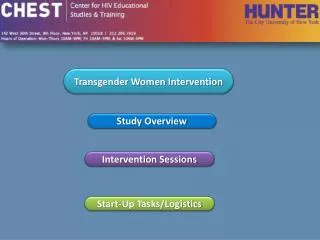
Transgender Women Intervention Study Overview Intervention Sessions Start-Up Tasks/Logistics
Study Overview 2011 – CDC identified transgender women (TW) as a group at significantly high risk for HIV infection due to several syndemic factors: • experiences of discrimination and stigma • health care providers’ insufficient cultural competence • elevated rates of sexual risk and substance use. • In response to the needs of this vulnerable and • overlooked group, we will expand a small-group, • peer-led HIV risk reduction intervention (Girlfriends) that showed evidence about its: • feasibility • cultural acceptability • preliminary efficacy
Study Overview • Together with our community partners, we intend to expand, refine and implement the original group-based intervention as a 7-session individual- and group-based program that may be scalable for community settings.
Study Overview • Intervention goals– • Reduce sexual risk, substance use • Increase stigma-coping and risk-buffering skills • Increase connection to and utilization of support services
Study Overview Timeline The study spans 5 years, and has 3 phases: • Phase 1: Identify and train peer health navigators; refine conditions with community partners • Phase 2: Pilot both conditions with 20 TW and modify conditions based on findings • Phase 3: Enroll 240 TW; evaluate intervention’s efficacy
Study Overview Who can participate? Who cannot participate? Eligibility Criteria Exclusion Criteria • AGE: 18 years of age or older • GENDER ID: Identify as transwoman • SEX BEHAVIOR: Report at least 3 acts of unprotected anal or vaginal sex in the past 90 days and at least 1 in the last 30 days • SUBSTANCE USE: Report at least 5 days of illicit drug use in the past 90 days and at least 2 in the last 30 • Provide contact information • Reside in the NYC metropolitan area • Able to complete a survey in English (Spanish-language assistance can be provided by bilingual staff). • Unstable, serious psychiatric symptoms; • Current suicidal/homicidal ideation • Evidence of gross cognitive impairment; or • Currently enrolled in a drug abuse treatment or enrolled in an HIV risk or drug use intervention study • Unable to communicate in English
InterventionProcedures Intervention Condition • Based in Motivational Interviewing (MI) “You can see that there are some problems here, but quitting altogether may not be what you want to do right now.” • And Cognitive-Behavioral Skills Training (CBST) “Mindfulness is The quality or state of being mindful… Or being Attentive, Heedful, Thoughtful Earnest, Intentional”
InterventionProcedures Intervention Sessions 1-4
InterventionProcedures Intervention Sessions 5-7
Study Procedures 1) Recruitment Field Screener Phone Screener Recruiter Recruiter/RA/Intern 2) Enrollment Intervention either PHN/RA Baseline or RA Wait List 3) Retention Wait List Intervention 4-Month 8-Month 12-Month RA RA RA PHN/RA
Study Procedures - Assessment What happens during appointments?
Study Procedures - Assessment 4-Month Baseline • ACASI Survey (30 minutes) • TLFB for sexual and drug use behavior in the last 30 days (20 minutes) • Recent drugusetest (5 minutes) • STI testing • 4-Month booster:Intervention – social reunion;Education – education review • Informed Consent process (20 minutes) • MMSE and Psych SCID • ACASI Survey (30 minutes) • TLFB for sexual and drug use behavior in the last 30 days (20 minutes) • Recent drugusetest (5 minutes) • HIV and STI counseling and testing (20-40 minutes) • Randomization 8-Month 12-Month • ACASI Survey (30 minutes) • TLFB for sexual and drug use behavior in the last 30 days (20 minutes) • Recent druguse test (5 minutes) • HIV and STI counseling and testing (20-40 minutes) • ACASI Survey (30 minutes) • TLFB for sexual and drug use behavior in the last 30 days (20 minutes) • Recent drugusetest (5 minutes) • STI testing
Study Procedures - Assessment Consent Process • Informed Consent process (20 minutes) • MMSE and Psych SCID • ACASI Survey (30 minutes) • TLFB for sexual and drug use behavior in the last 30 days (20 minutes) • Recent drug use test (5 minutes) • HIV and STI counseling and testing (20-40 minutes) • Randomization During the Consent process: • Explain the procedures and confidentiality to participant • Define responsibilities of the researcher • and the participant • Participant and researcher sign two • copies
Study Procedures - Assessment • Informed Consent process (20 minutes) • MMSE and Psych SCID • ACASI Survey (30 minutes) • TLFB for sexual and drug use behavior in the last 30 days (20 minutes) • Recent drug use test (5 minutes) • HIV and STI counseling and testing (20-40 minutes) • Randomization MMSE and Psych SCID MMSE: Mini-Mental State Exam (MMSE) • Screen for cognitive impairment – ask participant • to complete simple tasks, like drawing this Psych SCID: Structured Clinical Interview for DSM-IV • Questionnaire to determine whether participants have any psychiatric disorders that may prevent them from participating
Study Procedures - Assessment • Informed Consent process (20 minutes) • MMSE and Psych SCID • ACASI Survey (30 minutes) • TLFB for sexual and drug use behavior in the last 30 days (20 minutes) • Recent drug use test (5 minutes) • HIV and STI counseling and testing (20-40 minutes) • Randomization ACASI Survey Participants answer a bunch of questions about their experiences: mental health, sexual health, behavior, emotions, access to health care, etc… • This is all done online with audio assistance
Study Procedures - Assessment • Informed Consent process (20 minutes) • MMSE and Psych SCID • ACASI Survey (30 minutes) • TLFB for sexual and drug use behavior in the last 30 days (20 minutes) • Recent drug use test (5 minutes) • HIV and STI counseling and testing (20-40 minutes) • Randomization Timeline Follow-Back During the Timeline Follow-Back (TLFB), we collect information about our participants’ behavior: sex, drugs, and alcohol • We look at an actual digital calendar and enter this information live • For example…
Study Procedures - Assessment • Informed Consent process (20 minutes) • MMSE and Psych SCID • ACASI Survey (30 minutes) • TLFB for sexual and drug use behavior in the last 30 days (20 minutes) • Recent drug use test (5 minutes) • HIV and STI counseling and testing (20-40 minutes) • Randomization Drug Use Test Through a urine sample, we collect a test of recent drug use. This tests for: amphetamine, methamphetamine, marijuana, and cocaine/crack, and opiates • This is done to confirm what was reported on the TLFB
Study Procedures - Assessment • Informed Consent process (20 minutes) • MMSE and Psych SCID • ACASI Survey (30 minutes) • TLFB for sexual and drug use behavior in the last 30 days (20 minutes) • Recent drug use test (5 minutes) • HIV and STI counseling and testing (20-40 minutes) • Randomization HIV/STI Testing Callen-Lorde will be performing in-house HIV and STI counseling and testing
Study Procedures After the Baseline, participants are randomized to either the intervention or control (waitlist) condition. Participants are randomized stratifying by: • HIV Status • Age This way, there will be an even representation in both conditions Intervention either PHN/RA Baseline or Wait List
Study Procedures - Intervention 1) Recruitment Field Screener Phone Screener If randomized to: 2) Enrollment Intervention Baseline 3) Retention 4-Month 8-Month 12-Month
Study Procedures – Wait List 1) Recruitment Field Screener Phone Screener 2) Enrollment Baseline Wait List If randomized to: 3) Retention Wait List Intervention 4-Month 8-Month 12-Month 16-Month 20-Month