Procedure for Computing the Closure of Functional Dependencies
Understand how to compute the closure of a set of functional dependencies using reflexivity, augmentation, and transitivity rules with examples. Learn about reasoning with FDs, attribute sets closure, and computing the closure efficiently.

Procedure for Computing the Closure of Functional Dependencies
E N D
Presentation Transcript
To compute the closure of a set of functional dependencies F: F + = Frepeat for each functional dependency f in F+ apply reflexivity and augmentation rules on fadd the resulting functional dependencies to F +for each pair of functional dependencies f1and f2 in F + if f1 and f2 can be combined using transitivity then add the resulting functional dependency to F +until F + does not change any further NOTE: We shall see an alternative procedure for this task later Procedure for Computing F+
Example on Computing F+ • • F = {A → B, B → C, C D → E } • • Step 1: For each f in F, apply reflexivity rule • – We get: CD → C; CD → D • – Add them to F: • • F = {A → B, B → C, C D → E; CD → C; CD → D } • • Step 2: For each f in F, apply augmentation rule • – From A → B we get: A → AB; AB → B; AC → BC; AD • → BD; ABC →BC; ABD → BD; ACD →BCD • – From B → C we get: AB → AC; BC → C; BD → CD; • ABC → AC; ABD → ACD, etc etc. • • Step 3: Apply transitivity on pairs of f’s • • Keep repeating… You get the idea
Reasoning About FDs • Example: • Contracts(contract_id, supplier, project, dept, part, qty, value) • and: • – C is the key: C → CSJDPQV • – Project purchases each part using single contract: JP → C • – Dept purchases at most one part from a supplier: SD → P • • JP → C, C → CSJDPQV imply JP → CSJDPQV • • SD → P implies SDJ → JP • • SDJ → JP, JP → CSJDPQV imply SDJ → CSJDPQV
Reasoning About FDs • • Computing the closure of a set of FDs can be expensive. • (Size of closure is exponential in # of attrs!) • • Typically, we just want to check if a given FD X →Y is in • the closure of a set of FDs F. An efficient check: • – Compute attribute closure of X (denoted X+) wrt F: • • Set of all attributes Z such that X → Z is in F+ • • There is a linear time algorithm to compute this. • – Check if Y is in X+ • • Does F = {A → B, B → C, C D → E } imply A → E? • – i.e, is A → E in the closure F+? Equivalently, is E in A+?
Closure of Attribute Sets • Closure of a set of attributes X with respect to F is the set X+ of all attributes that are functionally determined by X • X+ can be calculated by repeatedly applying IR1, IR2, IR3 using the FDs in F
Closure of Attribute Sets • Given a set of attributes a, define the closureof aunderF (denoted by a+) as the set of attributes that are functionally determined by a under F • Algorithm to compute a+, the closure of a under F result := a;while (changes to result) do for each in F do begin if result then result := result end
Example of Attribute Set Closure • R = (A, B, C, G, H, I) • F = {A B, A C, CG H, CG I, B H} • (AG)+ 1. result = AG 2. result = ABCG (A C and A B) 3. result = ABCGH (CG H and CG AGBC) 4. result = ABCGHI (CG I and CG AGBCH) • Is AG a candidate key? • Is AG a super key? • Does AG R? == Is (AG)+ R • Is any subset of AG a superkey? • Does AR? == Is (A)+ R • Does GR? == Is (G)+ R
There are several uses of the attribute closure algorithm: Testing for superkey: To test if is a superkey, we compute +, and check if + contains all attributes of R. Testing functional dependencies To check if a functional dependency holds (or, in other words, is in F+), just check if +. That is, we compute + by using attribute closure, and then check if it contains . Is a simple and cheap test, and very useful Computing closure of F For each R, we find the closure +, and for each S +, we output a functional dependency S. Uses of Attribute Closure
Computing F+ • Given F={ A → B, B → C}. Compute F+ (with attributes A, B, C). We’ll do an example on A+. Step 1: Result = A Step 2: Consider A → B, Result = A ∪ B = AB Consider B → C, Result = AB ∪ C = ABC Step 3: A+ = {ABC}
Equivalence of Sets of FDs • Two sets of FDs F and G are equivalent if: - every FD in F can be inferred from G, & - every FD in G can be inferred from F • Hence, F and G are equivalent if F+=G+ Definition: F covers G if every FD in G can be inferred from F (i.e., if G+F+) • F and G are equivalent if F covers G and G covers F • There is an algorithm for checking equivalence of sets of FDs
Canonical Cover • Sets of functional dependencies may have redundant dependencies that can be inferred from the others • For example: A C is redundant in: {AB, BC} • Parts of a functional dependency may be redundant • E.g.: on RHS: {AB, BC, ACD} can be simplified to {A B, BC, AD} • E.g.: on LHS: {A B, BC, ACD} can be simplified to {A B, BC, AD} • Intuitively, a canonical cover of F is a “minimal” set of functional dependencies equivalent to F, having no redundant dependencies or redundant parts of dependencies
Extraneous Attributes • Consider a set F of functional dependencies and the functional dependency in F. • Attribute A is extraneous in if A and F logically implies (F – {}) {( – A) }. • Attribute A is extraneous in if A and the set of functional dependencies (F – {}) {(– A)} logically implies F. • Note: implication in the opposite direction is trivial in each of the cases above, since a “stronger” functional dependency always implies a weaker one • Example: Given F = {AC, ABC } • B is extraneous in AB C because {AC, AB C} logically implies AC (I.e. the result of dropping B from AB C). • Example: Given F = {AC, ABCD} • C is extraneous in ABCD since AB C can be inferred even after deleting C
Testing if an Attribute is Extraneous • Consider a set F of functional dependencies and the functional dependency in F. • To test if attribute A is extraneousin • compute ({} – A)+ using the dependencies in F • check that ({} – A)+ contains ; if it does, A is extraneous • To test if attribute A is extraneous in • compute + using only the dependencies in F’ = (F – {}) {(– A)}, • check that + contains A; if it does, A is extraneous
Canonical Cover • A canonical coverfor F is a set of dependencies Fc such that • F logically implies all dependencies in Fc, and • Fclogically implies all dependencies in F, and • No functional dependency in Fc contains an extraneous attribute, and • Each left side of functional dependency in Fcis unique. • To compute a canonical cover for F:repeatUse the union rule to replace any dependencies in F11 and 12 with 112 Find a functional dependency with an extraneous attribute either in or in If an extraneous attribute is found, delete it from until F does not change • Note: Union rule may become applicable after some extraneous attributes have been deleted, so it has to be re-applied
Computing Canonical Cover • R = (A, B, C)F = {A BC, B C, A B, ABC} • Combine A BC and A B into A BC • Set is now {A BC, B C, ABC} • A is extraneous in ABC • Check if the result of deleting A from ABC is implied by the other dependencies • Yes: in fact, BC is already present! • Set is now {A BC, B C} • C is extraneous in ABC • Check if A C is logically implied by A B and the other dependencies • Yes: using transitivity on A B and B C. • Can use attribute closure of A in more complex cases • The canonical cover is: A B, B C
Decomposition 1. Decomposing the schema R = ( bname, bcity, assets, cname, lno, amt) R = R1 U R2 R1 = (cname, lno, amt) R1 = (bname, bcity, assets, cname) 2. Decomposing the instance
Goals of Decomposition 1. Lossless Joins Want to be able to reconstruct big (e.g. universal) relation by joining smaller ones (using natural joins) (i.e. R1 R2 = R) 2. Dependency preservation Want to minimize the cost of global integrity constraints based on FD’s ( i.e. avoid big joins in assertions) 3. Redundancy Avoidance Avoid unnecessary data duplication (the motivation for decomposition) Why important? LJ : information loss DP: efficiency (time) RA: efficiency (space), update anomalies
Lossy Decomposition Spurious Tuples JOIN
Dependency Goal #1: lossless joins A bad decomposition: = Problem: join adds meaningless tuples “lossy join”: by adding noise, have lost meaningful information as a result of the decomposition
Dependency Goal #1: lossless joins Is the following decomposition lossless or lossy? Ans: Lossless: R = R1 R2, it has 4 tuples
Ensuring Lossless Joins A decomposition of R : R = R1 U R2 Is lossless iff R1 R2 R1, or R1 R2 R2 (i.e., intersecting attributes must for a superkey for one of the resulting smaller relations)
Lossless Decomposition Theorem A decomposition of R into R1 and R2 is lossless join wrt FDs F, if and only if at least one of the following dependencies is in F+: • R1 R2 R1 • R1 R2 R2 In other words, R1 R2 forms a superkey of either R1 or R2
Lossless Decomposition • Observe that S satisfies the FDs: • S# Status & S# City • It can not be a coincidence that S is equal to the join of its projections on {S#, Status} & {S#, City} • Heaths’ Theorem: Let R{A,B,C} be a relation, where A, B, & C are sets of attributes. If R satisfies AB & AC, then R is equal to the join of its projections on {A,B} & {A,C} • Observe that in the second decomposition of S the FD, S# City is lost
Lossless Decomposition • The decomposition of R into R1, R2, …Rn is lossless if for any instance r of R r = R1(r ) R2(r ) …… Rn(r ) • We can replace R by R1 & R2, knowing that the instance of R can be recovered from the instances of R1 & R2 • We can use FDs to show that decompositions are lossless
Decomposition Goal #2: Dependency preservation Goal: efficient integrity checks of FD’s An example w/ no DP: R = ( bname, bcity, assets, cname, lno, amt) bname bcity assets lno amt bname Decomposition: R = R1 U R2 R1 = (bname, assets, cname, lno) R2 = (lno, bcity, amt) Lossless but not DP. Why? Ans: bname bcity assets crosses 2 tables
Decomposition Goal #2: Dependency preservation To ensure best possible efficiency of FD checks ensure that only a SINGLE table is needed in order to check each FD i.e. ensure that: A1 A2 ... An B1 B2 ... Bm Can be checked by examining Ri = ( ..., A1, A2, ..., An, ..., B1, ..., Bm, ...) To test if the decomposition R = R1 U R2 U ... U Rn is DP (1) see which FD’s of R are covered by R1, R2, ..., Rn (2) compare the closure of (1) with the closure of FD’s of R
Decomposition Goal #2: Dependency preservation Example: Given F = { AB, AB D, C D} consider R = R1 U R2 s.t. R1 = (A, B, D) , R2 = (C, D) (1) F+ = { ABD, CD}+ (2) G = {ABD, CD, ...} + (3) F+ = G+ note: G+ cannot introduce new FDs not in F+ Decomposition is DP
Dependency Preservation • Let Fibe the set of dependencies F + that include only attributes in Ri. • A decomposition is dependency preserving, if (F1 F2 … Fn )+ = F + • If it is not, then checking updates for violation of functional dependencies may require computing joins, which is expensive.
To check if a dependency is preserved in a decomposition of R into R1, R2, …, Rn we apply the following test (with attribute closure done with respect to F) result = while (changes to result) dofor eachRiin the decompositiont = (result Ri)+ Riresult = result t If result contains all attributes in , then the functional dependency is preserved. We apply the test on all dependencies in F to check if a decomposition is dependency preserving This procedure takes polynomial time, instead of the exponential time required to compute F+and(F1 F2 … Fn)+ Testing for Dependency Preservation
Example • R = (A, B, C)F = {A B, B C) • Can be decomposed in two different ways • R1 = (A, B), R2 = (B, C) • Lossless-join decomposition: R1 R2 = {B}and B BC • Dependency preserving • R1 = (A, B), R2 = (A, C) • Lossless-join decomposition: R1 R2 = {A}and A AB • Not dependency preserving (cannot check B C without computing R1 R2)
Decomposition Goal #3: Redudancy Avoidance Example: Redundancy for B=x , y and z (1) An FD that exists in the above relation is: B C (2) A superkey in the above relation is A, (or any set containing A) When do you have redundancy? Ans: when there is some FD, XY covered by a relation and X is not a superkey
Problems with Decompositions There are three potential problems to consider: • Some queries become more expensive • e.g., What is the price of prop# 1? • Given instances of the decomposed relations, we may not be able to reconstruct the corresponding instance of the original relation! • Fortunately, not in the PLOTS example • Checking some dependencies may require joining the instances of the decomposed relations. • Fortunately, not in the PLOTS example Tradeoff:Must consider these issues vs. redundancy
Example • R = (A, B, C )F = {AB B C}Key = {A} • R is not in BCNF (B C but B is not superkey) • Decomposition R1 = (A, B), R2 = (B, C) • R1and R2 in BCNF • Lossless-join decomposition • Dependency preserving
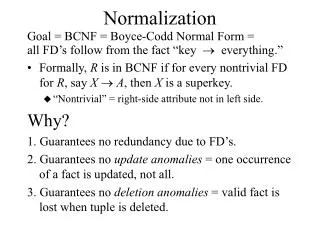
Testing for BCNF • To check if a non-trivial dependency causes a violation of BCNF 1. compute + (the attribute closure of ), and 2. verify that it includes all attributes of R, that is, it is a superkey of R. • Simplified test: To check if a relation schema R is in BCNF, it suffices to check only the dependencies in the given set F for violation of BCNF, rather than checking all dependencies in F+. • If none of the dependencies in F causes a violation of BCNF, then none of the dependencies in F+ will cause a violation of BCNF either. • However, simplified test using only F isincorrectwhen testing a relation in a decomposition of R • Consider R = (A, B, C, D, E), with F = { A B, BC D} • Decompose R into R1 =(A,B) and R2 =(A,C,D, E) • Neither of the dependencies in F contain only attributes from (A,C,D,E) so we might be mislead into thinking R2 satisfies BCNF. • In fact, dependency ACD in F+ shows R2 is not in BCNF.
BCNF and Dependency Preservation It is not always possible to get a BCNF decomposition that is dependency preserving • R = (J, K, L )F = {JK L L K }Two candidate keys = JK and JL • R is not in BCNF • Any decomposition of R will fail to preserve JK L This implies that testing for JK L requires a join
Third Normal Form: Motivation • There are some situations where • BCNF is not dependency preserving, and • efficient checking for FD violation on updates is important • Solution: define a weaker normal form, called Third Normal Form (3NF) • Allows some redundancy (with resultant problems; we will see examples later) • But functional dependencies can be checked on individual relations without computing a join. • There is always a lossless-join, dependency-preserving decomposition into 3NF.
Redundancy in 3NF • There is some redundancy in this schema • Example of problems due to redundancy in 3NF • R = (J, K, L)F = {JK L, L K } J L K j1 j2 j3 null l1 l1 l1 l2 k1 k1 k1 k2 • repetition of information (e.g., the relationship l1, k1) • (i_ID, dept_name) • need to use null values (e.g., to represent the relationshipl2, k2 where there is no corresponding value for J). • (i_ID, dept_nameI) if there is no separate relation mapping instructors to departments
Testing for 3NF • Optimization: Need to check only FDs in F, need not check all FDs in F+. • Use attribute closure to check for each dependency , if is a superkey. • If is not a superkey, we have to verify if each attribute in is contained in a candidate key of R • this test is rather more expensive, since it involve finding candidate keys • testing for 3NF has been shown to be NP-hard • Interestingly, decomposition into third normal form (described shortly) can be done in polynomial time
3NF Decomposition Algorithm Let Fcbe a canonical cover for F;i := 0;for each functional dependency in Fcdo if none of the schemas Rj, 1 j i contains then begini := i + 1;Ri := endif none of the schemas Rj, 1 j i contains a candidate key for Rthen begini := i + 1;Ri := any candidate key for R;end /* Optionally, remove redundant relations */ repeatif any schema Rj is contained in another schema Rkthen /* delete Rj */Rj = R;; i=i-1;return (R1, R2, ..., Ri)
Testing Decomposition for BCNF • To check if a relation Ri in a decomposition of R is in BCNF, • Either test Ri for BCNF with respect to the restriction of F to Ri (that is, all FDs in F+ that contain only attributes from Ri) • or use the original set of dependencies F that hold on R, but with the following test: • for every set of attributes Ri, check that + (the attribute closure of ) either includes no attribute of Ri- , or includes all attributes of Ri. • If the condition is violated by some in F, the dependency (+ - ) Rican be shown to hold on Ri, and Ri violates BCNF. • We use above dependency to decompose Ri
BCNF Decomposition Algorithm result := {R };done := false;compute F +;while (not done) do if (there is a schema Riin result that is not in BCNF)then beginlet be a nontrivial functional dependency that holds on Risuch that Riis not in F +, and = ;result := (result – Ri ) (Ri – ) (, );end else done := true; Note: each Riis in BCNF, and decomposition is lossless-join.
Example of BCNF Decomposition • class (course_id, title, dept_name, credits, sec_id, semester, year, building, room_number, capacity, time_slot_id) • Functional dependencies: • course_id→ title, dept_name, credits • building, room_number→capacity • course_id, sec_id, semester, year→building, room_number, time_slot_id • A candidate key {course_id, sec_id, semester, year}. • BCNF Decomposition: • course_id→ title, dept_name, credits holds • but course_id is not a superkey. • We replace class by: • course(course_id, title, dept_name, credits) • class-1 (course_id, sec_id, semester, year, building, room_number, capacity, time_slot_id)
BCNF Decomposition (Cont.) • course is in BCNF • How do we know this? • building, room_number→capacity holds on class-1 • but {building, room_number} is not a superkey for class-1. • We replace class-1 by: • classroom (building, room_number, capacity) • section (course_id, sec_id, semester, year, building, room_number, time_slot_id) • classroom and section are in BCNF.