Understanding Volcanic Eruptions: Types, Behavior, and Effects
Volcanic eruptions are complex natural disasters characterized by the release of magma, gas, and ash. The composition of magma plays a critical role in determining the eruption's behavior, with higher silica content leading to increased viscosity and more explosive eruptions. Key volcanic products include lava flows, pyroclastic materials, and poisonous gas emissions, all of which can have profound effects on the environment and human health. Secondary consequences like mudflows and atmospheric disruptions may further impact the surrounding areas, leading to famine and disease.

Understanding Volcanic Eruptions: Types, Behavior, and Effects
E N D
Presentation Transcript
Natural Disasters Volcanoes: Materials & Effects
Nature of Volcanic Activity • Volcanic eruptions are caused by magma(liquid rock, crystals and dissolved gas) expelled onto the Earth’s surface
Types of Magma Basalt Dark color SiO2 – 45-55 wt.% 1,000-1,200°C Rhyolite Light color SiO2 – 65-75wt.% 650-800°C Andesite Intermediate color SiO2 – 55-65 wt.% 800-1,000°C
Magma Viscosity • A fluid’s resistance to flow • Depends primarily on: • Composition • Temperature • Composition • ↑ SiO2 ↑ viscosity • Temperature • ↑ T ↓ viscosity
Volcanic Behavior • The nature of volcanic eruptions depends on composition; hence, its viscosity • Viscosity is an important property in determining the eruptive behavior of magmas • ↑ viscosity explosive eruption • ↓ viscosity quiet eruption
Primary Effects of Volcanic Eruptions Lava Pyroclastic Material Poisonous Gas Emissions
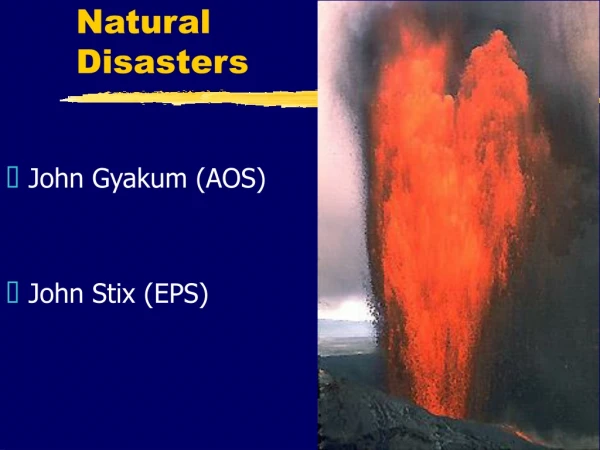
Lava Flows • Aa • Rough, jagged • High Viscosity • Low temperature • Pahoehoe • Ropy, smooth • Low viscosity • High temperature Hawaii Eruption
Pyroclastic Material • Ash falls • Clouds of gas and volcanic ash rise in eruption column • Ash picked up by wind and falls back to surface • Pyroclastic flows • If eruption column collapses, gas and ash rush down flanks of volcanoes at high speeds • Ash become fused and become welded ash
Pyroclastic Material • If gas pressure is directed outward instead of upward, produce a lateral blast or surge – a high-speed ash-rich shock wave
Poisonous Gas Emissions • Carbon Dioxide (CO2) • More dense than oxygen • Lethal if concentration >10% • As magma rises, gas comes out of solution
Secondary & Tertiary Effects Mudflows Debris Avalanches & Flows Atmospheric Effects Famine and Disease
Mudflows • Mudflows, also called lahars, is a mixture of water and sediment, which moves rapidly down slope along existing stream valleys
Debris Avalanche and Flows • Ground-hugging avalanche or flow composed of hot ash, pumice, rock fragments and dust
Atmospheric Effects • Volcanic ash may stay suspended in atmosphere for years • Ash may reflect solar radiation and cause global cooling • Gas, like SO2, also reflects sunlight
Famine and Disease • Ash falls destroy crops and animals (including humans) that feed on them • Decaying organisms may contaminate water and spread disease
Case Histories • Versuvius, (79 A.D.)
Case Histories • Mt. Pelée, Martinique (1902)
Case Histories • Mount St. Helens (1980)