Local search algorithms
This piece explores various search algorithms used in optimization problems, highlighting techniques such as hill-climbing, simulated annealing, and local beam search. We delve into classic examples such as the Traveling Salesman Problem and the n-Queens Problem, examining their state spaces and objective functions. Although these algorithms can efficiently find solutions, they may get stuck in local optima. Strategies for escaping such traps and improving search outcomes are discussed, helping to enhance problem-solving efficiency in complex scenarios.

Local search algorithms
E N D
Presentation Transcript
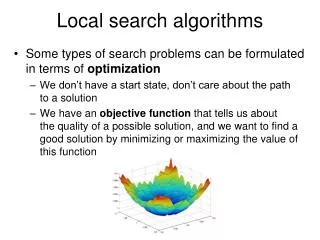
Local search algorithms • Some types of search problems can be formulated in terms of optimization • We don’t have a start state, don’t care about the path to a solution • We have an objective function that tells us about the quality of a possible solution, and we want to find a good solution by minimizing or maximizing the value of this function
Example: Traveling salesman problem • Find the shortest tour connecting a given set of cities • State space: all possible tours • Objective function: length of tour
Example: n-queens problem • Put n queens on an n × n board with no two queens on the same row, column, or diagonal • State space: all possible n-queen configurations • What’s the objective function? • Number of pairwise conflicts
Hill-climbing (greedy) search • Idea: keep a single “current” state and try to locally improve it • “Like climbing mount Everest in thick fog with amnesia”
Example: n-queens problem • Put n queens on an n × n board with no two queens on the same row, column, or diagonal State space: all possible n-queen configurations • Objective function: number of pairwise conflicts • What’s a possible local improvement strategy? • Move one queen within its column to reduce conflicts
Example: n-queens problem • Put n queens on an n × n board with no two queens on the same row, column, or diagonal State space: all possible n-queen configurations • Objective function: number of pairwise conflicts • What’s a possible local improvement strategy? • Move one queen within its column to reduce conflicts h = 17
Example: Traveling Salesman Problem • Find the shortest tour connecting n cities • State space: all possible tours • Objective function: length of tour • What’s a possible local improvement strategy? • Start with any complete tour, perform pairwise exchanges A B A B C C D E D E ABCED ABDEC
Hill-climbing (greedy) search • Initialize current to starting state • Loop: • Let next= highest-valued successor of current • If value(next) < value(current) return current • Else let current = next • Variants: choose first better successor, randomly choose among better successors
Hill-climbing search • Is it complete/optimal? • No – can get stuck in local optima • Example: local optimum for the 8-queens problem h = 1
The state space “landscape” • How to escape local maxima? • Random restart hill-climbing • What about “shoulders”? • What about “plateaux”?
Local beam search • Start with k randomly generated states • At each iteration, all the successors of all k states are generated • If any one is a goal state, stop; else select the k best successors from the complete list and repeat • Is this the same as running k greedy searches in parallel? Greedy search Beam search
Simulated annealing search • Idea: escape local maxima by allowing some "bad" moves but gradually decrease their frequency • Probability of taking downhill move decreases with number of iterations, steepness of downhill move • Controlled by annealing schedule • Inspired by tempering of glass, metal
Simulated annealing search • Initializecurrentto starting state • For i = 1 to If T(i) = 0 return current Let next = random successor of current Let = value(next) – value(current) If > 0 then let current = next Else let current = next with probability exp(/T(i))
Effect of temperature exp(/T)
Simulated annealing search • One can prove: If temperature decreases slowly enough, then simulated annealing search will find a global optimum with probability approaching one • However: • This usually takes impractically long • The more downhill steps you need to escape a local optimum, the less likely you are to make all of them in a row • More modern techniques: general family of Markov Chain Monte Carlo (MCMC) algorithms for exploring complicated state spaces