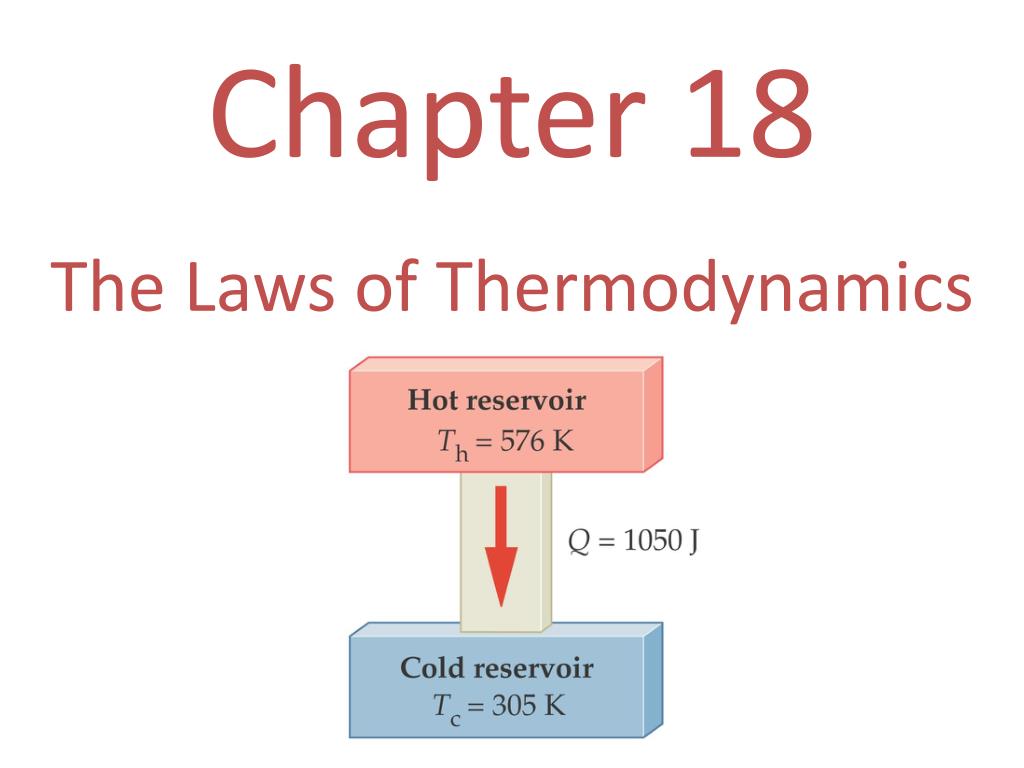
Chapter 18 The Laws of Thermodynamics. Thermodynamics. The study of heat and its transformation into mechanical work. 18-1 The Zeroth Law of Thermodynamics. We have already discussed the zeroth law, and include it here for completeness:
Une image / un lien ci-dessous est fourni (tel quel) pour télécharger la présentation
Politique de téléchargement : le contenu du site vous est fourni TEL QUEL pour votre information et votre usage personnel ; il ne peut être vendu, concédé sous licence ni partagé sur d’autres sites sans l’accord de son auteur.Le contenu vous est fourni TEL QUEL, pour votre information et votre usage personnel uniquement.Téléchargez la présentation en cliquant sur ce lien.Lors du téléchargement, si vous ne parvenez pas à télécharger une présentation, l’éditeur a peut-être supprimé le fichier de son serveur.Pendant le téléchargement, si vous ne parvenez pas à obtenir une présentation, le fichier a peut-être été supprimé par l’éditeur.
Thermodynamics The study of heat and its transformation into mechanical work.
18-1 The Zeroth Law of Thermodynamics We have already discussed the zeroth law, and include it here for completeness: If object A is in thermal equilibrium with object C, and object B is separately in thermal equilibrium with object C, then objects A and B will be in thermal equilibrium if they are placed in thermal contact.
Work done by a gas - Suppose you had a piston filled with a specific amount of gas. As you add heat, the temperature rises and thus the volume of the gas expands. The gas then applies a force on the piston wall pushing it a specific displacement. Thus it can be said that a gas can do WORK.
Work is the AREA of a P vs. V graph The “negative” sign in the equation for WORK is often misunderstood. Since work done BY a gas has a positive volume change we must understand that the gas itself is USING UP ENERGY or in other words, it is losing energy, thus the negative sign. When work is done ON a gas the change in volume is negative. This cancels out the negative sign in the equation. This makes sense as some EXTERNAL agent is ADDING energy to the gas.
The “negative” sign in the equation for WORK is often misunderstood. Since work done BY a gas has a positive volume change we must understand that the gas itself is USING UP ENERGY or in other words, it is losing energy, thus the negative sign. When work is done ON a gas the change in volume is negative. This cancels out the negative sign in the equation. This makes sense as some EXTERNAL agent is ADDING energy to the gas.
Example Sketch a PV diagram and find the work done by the gas during the following stages. • A gas is expanded from a volume of 1.0 L to 3.0 L at a constant pressure of 3.0 atm. • The gas is then cooled at a constant volume until the pressure falls to 2.0 atm 600 J
Example continued • The gas is then compressed at a constant pressure of 2.0 atm from a volume of 3.0 L to 1.0 L. • The gas is then heated until its pressure increases from 2.0 atm to 3.0 atm at a constant volume. -400 J
Example continued What is the NET WORK? NET work is the area inside the shape. 600 J + -400 J = 200 J Rule of thumb: If the system rotates CW, the NET work is positive. If the system rotates CCW, the NET work is negative.
Internal Energy (DU) All of the energy inside a system is called INTERNAL ENERGY, DU. When you add HEAT(Q), you are adding energy and the internal energy INCREASES. Both are measured in joules. But when you add heat, there is usually an increase in temperature associated with the change.
The First Law of Thermodynamics The first law of thermodynamics is a statement of the conservation of energy. If a system’s volume is constant, and heat is added, its internal energy increases.
The First Law of Thermodynamics If a system does work on the external world, and no heat is added, its internal energy decreases.
First Law of Thermodynamics “The internal energy of a system tend to increase when HEAT is added and work is done ON the system.” Suggests a CHANGE or subtraction You are really adding a negative here! The bottom line is that if you ADD heat then transfer work TO the gas, the internal energy must obviously go up as you have MORE than what you started with.
The First Law of Thermodynamics Combining these gives the first law of thermodynamics. The change in a system’s internal energy is related to the heat Q and the work W as follows: It is vital to keep track of the signs of Q and W.
DU = Q + W DU: change in internal energy of system(J) Q: heat added to the system (J). This heat exchange is driven by temperature difference. W: work done on the system (J). Work will be related to the change in the system’s volume. This law is sometimes paraphrased as “you can’t win”.
The thermodynamic state of a gas is defined by pressure, volume, and temperature. • A gas process describes how gas gets from one state to another state. • Processes depend on the behavior of the boundary and the environment more than they depend on the behavior of the gas.
Isothermal Processes This is an idealized reversible process. The gas is compressed; the temperature is constant, so heat leaves the gas. As the gas expands, it draws heat from the reservoir, returning the gas and the reservoir to their initial states. The piston is assumed frictionless.
Isobaric Process Heat is added to the gas which increases the Internal Energy (U) Work is done by the gas as it changes in volume. The path of an isobaric process is a horizontal line called an isobar. ∆U = Q - W can be used since the WORK is POSITIVE in this case
18-3 Thermal Processes Another way to ensure that a process is effectively adiabatic is to have the volume change occur very quickly. In this case, heat has no time to flow in or out of the system.
Isobaric Work Question: How does the pressure of an isobarically expanding gas affect the amount of work it does? Work done by a cycle: What is DU for the gas in a complete cycle? What is changed when a gas undergoes a complete cycle?
Second Law of Thermodynamics • “No process is possible whose sole result is the complete conversion of heat from a hot reservoir into mechanical work. (Kelvin-Planck statement.) • No process is possible whose sole result is the transfer of heat from a cooler to a hotter body. (Clausius statement.) • The bottom line: • Heat always flows from a hot body to a cold body • Nothing is 100% efficient
Heat engines can convert heat into useful work. • According to the 2nd Law of Thermodynamics. Heat engines always produce some waste heat. • Efficiency can be used to tell how much heat is needed to produce a given amount of work. • NOTE: A heat engine is not something that produces heat. A heat engine transfers heat from hot to cold, and does mechanical work in the process.