Download
1 / 4
40 likes | 165 Vues
This exploration delves into the foundational role of the judiciary within the U.S. governance system, addressing key questions such as the purpose of judicial review and the implications of life tenure for federal judges. It discusses the evolution of the courts, key cases like Marbury v. Madison and Roe v. Wade, and examines the balance between traditional, activist, and originalist interpretations of the law. The necessity of independent judges is highlighted, alongside the historical context of jurisprudence in shaping political liberty and state sovereignty.

E N D
Establishing the Judiciary Wilson 16A
Objective Questions Who Governs? To What Ends? Why should federal courts be able to declare laws unconstitutional? Should federal judges only interpret existing laws or should they be able to create new laws? • Why should federal judges serve for life? • How does the make up of the Court influence jurisprudence?
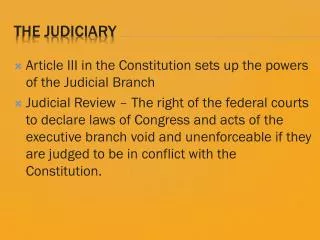
Judicial Review • Right to rule a law or action unconstitutional • Need independent judges • Hamilton – Federalist 78 • Great Britain • Appointment and tenure • Jurisprudence • Traditional • Activist • Originalist • Krytocracy – rule by judges
Evolution of the courts • National supremacy and slavery • Marbury v. Madison • McCulloch v. Maryland • Dred Scot v. Sanford • Government and the economy • Plessy v. Ferguson • Schenck v. US • Political liberty – Brown v. BEO-Topeka • State sovereignty – Roe v. Wade