Unlocking Humanity: Comparative Genomics and the Unique Genes Defining Homo Sapiens
90 likes | 229 Vues
This article explores the genetic distinctions between humans and primates, identifying nearly 200 genes unique to our species that play crucial roles in defining humanity. It highlights the significance of models like the rhesus monkey for studying HIV, given their response to simian immunodeficiency virus (SIV). Furthermore, the paper delves into advancements in bioinformatics, from classical gene prediction techniques to modern approaches in functional genomics, protein networking, and the implications for personalized medicine.


Unlocking Humanity: Comparative Genomics and the Unique Genes Defining Homo Sapiens
E N D
Presentation Transcript
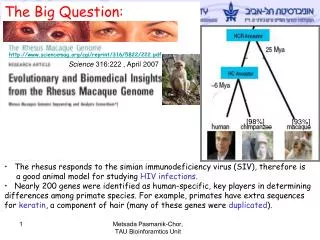
http://www.sciencemag.org/cgi/reprint/316/5822/222.pdf Science 316:222 , April 2007 The Big Question: What makes us human ? What genes primates share and what genes are uniquely human ? [98%] [93%] • The rhesus responds to the simian immunodeficiency virus (SIV), therefore is • a good animal model for studying HIV infections. • Nearly 200 genes were identified as human-specific, key players in determining differences among primate species. For example, primates have extra sequences for keratin, a component of hair (many of these genes were duplicated). Metsada Pasmanik-Chor, TAU Bioinforamtics Unit
From Classical to Post-Genomic Bioinformatics • Classical: • Information management and data-mining. • Sequence analysis and interpretation • (comparisons and alignments), • evolutionary relationships. • Gene prediction and regulation. • Protein structural biology. • Global (Post-genomic): • Functional genomics. • Protein functional sites prediction, drug design and “personalized medicine”. • Protein networks and systems biology. Metsada Pasmanik-Chor, TAU Bioinforamtics Unit
Information management - Biological Databases & Software (e.g. NCBI) Metsada Pasmanik-Chor, TAU Bioinforamtics Unit
Leghemoglobin Myoglobin a-Globin Yellow Lupine Whale Human Alignments (pairwise, multiple, structures) Multiple alignment: find protein families and functional domains. conserved How conserved ? Metsada Pasmanik-Chor, TAU Bioinforamtics Unit
CTATAAATGC A C CTATAAATGC A C Sequence Conservation Suggests Functionality divergence conserved CTATAAATGC A C AGTTGAAAC GGAGCTGATGGAGC GGTGGGC T 80 million years CTATAAATGC A C TACATTTCG ACTGTATCGCCTCG CAACCCT A potential functional region Conservation scale sequence Metsada Pasmanik-Chor, TAU Bioinforamtics Unit http://www.pgaeducation.org/tutoria/WUSTL/BerkeleyPGACompGeno_Boffelli.2.ppt#325,4,Slide
Gene Prediction and Regulation Approaches: Pattern finding: long ORF, splice-junctions, transcription signals: start and stop codons, promoter signals (TATA boxes, transcription factor (TF) binding sites, CpG islands and methylation patterns), Poly(A) signals, etc. Comparative genomics approach: ESTs and cDNA database comparisons, protein family homology. Experimental confirmation of gene predictions: use high-throughput methods. The central dogma of gene expression (eukaryotes) Metsada Pasmanik-Chor, TAU Bioinforamtics Unit http://cbis.anu.edu.au/bioinfosummer-2003/tuesday/13h30-14h30_speed_keynote.ppt#4 http://www.cs.odu.edu/~pothen/Courses/CS791/zhang.pdf
Genome Browsers Metsada Pasmanik-Chor, TAU Bioinforamtics Unit
The Post Genome Era - using genome scale technologies • Complex system analysis – • Gene regulation, function of non-coding sequences. • Understand wide gene expression sets, protein expression and post- translational modifications, protein networks and complexes. • Identify multi-gene diseases. • Variations among individuals, correlation of SNPs with health and disease, disease susceptibility. • Identify disease causes and design “personal” drugs, new drug design. Metsada Pasmanik-Chor, TAU Bioinforamtics Unit
The Post Genome Era–High Throughput Functional Genomics “The greatest challenge, however, is analytical…. Deeper biological insight is likely to emerge from examining datasets with scores of samples”… http://www.blackwell-synergy.com/doi/pdf/10.1111/j.1440-1681.2006.04398.x Metsada Pasmanik-Chor, TAU Bioinforamtics Unit