Enhancing CMB Detection: The Wisconsin Small Telescope Array for Radio Waves (WSTAR)
190 likes | 328 Vues
The Wisconsin Small Telescope Array for Radio Waves (WSTAR) aims to investigate new beam-combination techniques to reduce systematic errors in detecting Cosmic Microwave Background (CMB) anisotropies and to map the 21-cm emission line. Under the guidance of Prof. Peter Timbie, participants developed and modified hardware and software while focusing on improving detection methods, particularly through interferometry. This initiative not only aims to advance cosmological measurements but also serves as a practical training ground for undergraduate students in radio astronomy.


Enhancing CMB Detection: The Wisconsin Small Telescope Array for Radio Waves (WSTAR)
E N D
Presentation Transcript
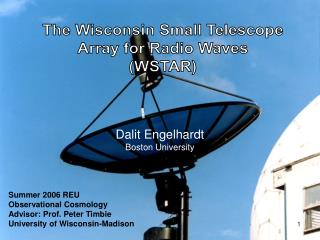
The Wisconsin Small Telescope Array for Radio Waves (WSTAR) Dalit Engelhardt Boston University Summer 2006 REU Observational Cosmology Advisor: Prof. Peter Timbie University of Wisconsin-Madison
Outline • Objectives • CMB anisotropies and detection • beam-combination techniques • WSTAR design • Personal contributions
WSTAR Objectives • Investigate alternate beam-combination techniques to minimize systematic errors in detecting CMB anisotropies. • Map 21-cm emission line • Use in undergraduate education and training in radio astronomy
CMB Anisotropies (I) • Matter distribution • Temperature variations < 100 μK • Polarization: “E modes” variation < 1 μK • Spatial effects / gravitational waves • Polarization: “B modes” variation of tens of nK
CMB Anisotropies (II) WMAP image of the CMB. Courtesy of CASA, University of Colorado at Boulder
Detecting the CMB • Current detection methods different systematic effects • Imaging systems (e.g. WMAP) • Interferometers: combine signals by means of wave interference to produce higher-resolution, clearer images • Problems: • CMB frequencies up to 140 GHz no appropriate low-noise amplifiers • CMB detection requires large arrays amount of computation needed
Correlation (Multiplying) Interferometer E1 E2 • Signal loss due to voltage dividing need good amplifiers • Computational complexity: n(n-1)/2 correlations needed for n antennas En Amplifier … Voltage / electronic divider × ×
Adding Interferometer E1 E2 En • No signal loss due to voltage splitting • Computational algorithm less complicated feasible for large arrays necessary for CMB Phase shifter … + E1 + E2 + … + En Detector (E1 + E2 + … + En )2
21-cm Emission Line • Emission mechanism • Transition at ground state • f = 1420.4 MHz • E = 5.9 ×10⁻⁶ eV • RARE transition, but many H atoms in the universe • Why 21-cm line? • Clear sky (low atmospheric interference) • Large signals • Availability of data from other experiments • Relatively low frequency (but still in CMB range) easy to build equipment • Computational data analysis algorithms same at low and high frequencies
WSTAR Design • Array setup • 30 ft initial spacing (but variable) • 3 small radio telescopes • Haystack Observatory design, built from scratch by undergraduates at ObsCos • Control boards on roof of Chamberlin, manual control planned from lab • Hardware • Software
Personal Contributions / Design Modifications • Software (java-based code) modifications • OS environment alteration • Hardware changes
Looking ahead… • Receiver board to Haystack Observatory • Remote access to the telescope via TCP/IP • Testing • Remaining two array telescopes • Testing in different interferometry configurations
Special Thanks • Peter Timbie • ObsCos group • UW-Madison REU • National Science Foundation (NSF)
References • Center for Astropohysics and Astronomy, University of Colorado at Boulder,http://casa.colorado.edu/ • Minnesota State University, Mankato, http://Odin.physastro.mnsu.edu • MIT Haystack Observatory, http://www.haystack.mit.edu/edu/undergrad/srt/ • Various papers and articles read in the course of the program that have gradually entered the subconscious…
CMB Anisotropies WMAP image of the CMB Courtesy of NASA / WMAP Science Team