Understanding Units of Capacity in Metric and U.S. Measurement Systems
This section explores the concept of capacity, focusing on units used to measure liquids. It compares common U.S. capacity units like gallons, quarts, pints, and cups to metric units including liters and milliliters. The basic unit of capacity in the metric system, the liter, is explained along with its decimal-based prefixes for easy conversion. Practical examples illustrate how these units are applied in everyday situations, such as cooking and selling liquids, making it essential for understanding measurements in both systems.

Understanding Units of Capacity in Metric and U.S. Measurement Systems
E N D
Presentation Transcript
Section 9.6 Capacity
Units ofcapacityare generally used to measure liquids. The number of gallons of gasoline needed to fill a gas tank in a car, the number of cups of water needed in a bread recipe, and the number of quarts of milk sold each day at a supermarket are all examples of using units of capacity. Martin-Gay, Prealgebra, 5ed
U.S. Units of Capacity Unit Fractions 8 fluid ounces (fl oz) = 1 cup (c) 2 cups = 1 pint (pt) 2 pints = 1 quart (qt) 4 quarts = 1 gallon (g) Martin-Gay, Prealgebra, 5ed
10 cm 10 cm 10 cm Capacity: Metric System of Measurement The liter is the basic unit of capacity in the metric system. A liter is the capacity or volume of a cube measuring 10 centimeters on each side.
Metric System of Measurement Prefix kilo hecto deka deci centi milli Meaning 1000 100 10 1/10 1/100 1/1000 Metric Unit of Length 1 kiloliter (kl) = 1000 liters (L) 1 hectoliter (hl) = 100 L 1 dekaliter (dal) = 10 L 1 liter (L) = 1 L 1 deciliter (dl) = 1/10 or 0.1 L 1 centiliter (cl) = 1/100 or 0.01 L 1 milliliter (ml) = 1/1000 or 0.001 L The prefixes for metric units of capacity are the same as for metric units of length and mass. Martin-Gay, Prealgebra, 5ed
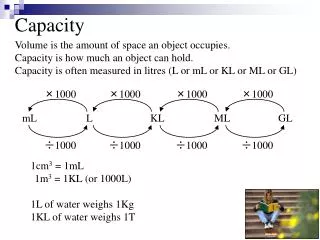
Start End 3 units to the left 3 places to the left The two most commonly used units of capacity in the metric system are the milliliterand the liter. As with length and mass, all units of capacity are powers of 10 of the liter, so converting from one unit of capacity to another only involves moving the decimal point. kl hl dal L dl cl ml Using the listing of units of capacity, convert 5350 ml to liters. 5350 ml = 5.350 L Martin-Gay, Prealgebra, 5ed