Download
1 / 6
60 likes | 180 Vues
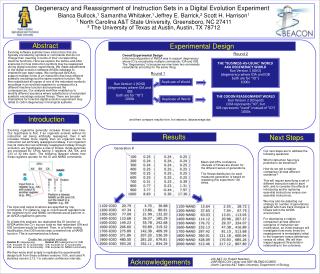
This study explores the modification of the Avida digital evolution platform to enhance genetic code reassignment. We analyze methods for controlling code evolution over 1000 generations while focusing on specific codon modifications. Key topics include monitoring Avida evolution, optimizing performance through parallel processing, and the implications of changing the source code. Insights from previous research on Escherichia coli's genetic code reassignment provide a foundational understanding of molecular evolution and its application in Avida.

E N D
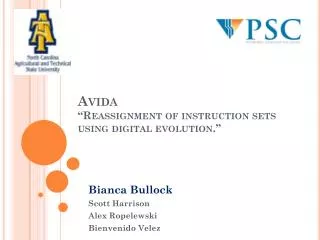
Avida“Reassignment of instruction sets using digital evolution.” Bianca Bullock Scott Harrison Alex Ropelewski Bienvenido Velez
Software Engineering Original • Modifying the source code of the software • How to control the code in other directions? 1000 generations Codon Reassingment S.P. 1001-2000 Clone 1001-2000 • Which codes are we trying to modify? • What is IOIO AUG|GUG|UGA UAA UAG Stop codons Mukai, T., Hayashi, A., Iraha, F., Sato, A., Ohtake, K., Yokoyama, S., & Sakamoto, K. (2010). Codon reassignment in the Escherichia coli genetic code. Nucleic acids research, 38(22), 8188-8195. http://nar.oxfordjournals.org/content/38/22/8188.full
How do we monitor and supercompute AVIDA evolution? • Which AVIDA organism is better and why? • What happened and when? Organism from generation 483 Ancestor organism
Running Avida • Blacklight • Writing a recursive script • Parallel instead of serial processing of multiple replicate Avida experiments
Altering Avida • What is the purpose of altering the Avida source code? • What is the purpose of identifying the phenotype of an organism? • Why are we minimizing runtime?
Acknowledgements • Pat Sudac (PSC) • Alex Ropelewski (PSC) • PallaviIshwad (PSC) • Luis Vázquez-Quiñones (PSC) • Hugh Nicholas (PSC) • Scott Harrison (NCAT) • Robert Newman (NCAT) • Bienvenido Velez (UPRM)