Download
1 / 15
150 likes | 273 Vues
This chapter explores the anatomy and function of the ear, detailing its structures and their roles in hearing and maintaining balance. The external ear, middle ear, and inner ear are described, highlighting components like the auricle, tympanic membrane, ossicles, cochlea, and semicircular canals. It covers common medical terms such as otomycosis and tympanitis, along with disorders like Meniere's disease and tinnitus. The text also introduces key surgical and diagnostic terms associated with ear health, making it a comprehensive resource for understanding ear anatomy.

E N D
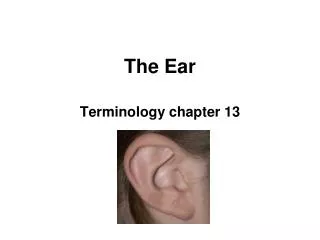
The Ear Terminology chapter 13
Function • To hear • To provide the sense of balance
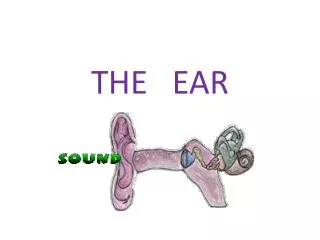
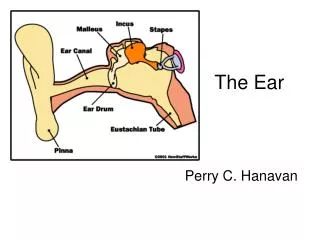
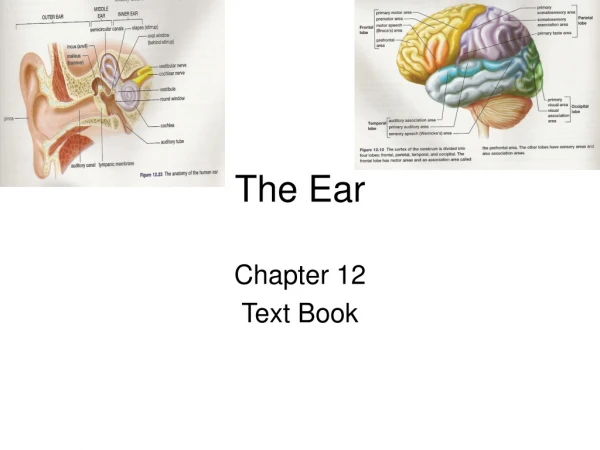
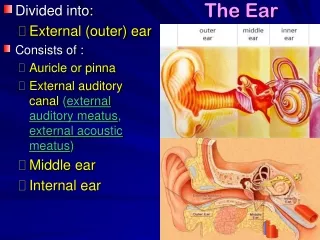
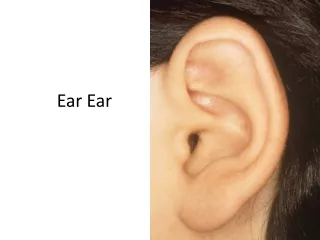
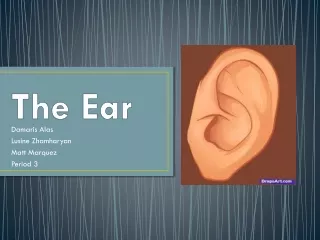
Structure of the Ear • External ear • Auricle (pinna) to the eardrum • Directs sound waves into the ear
Structure of the Ear • Middle ear • Eardrum (tympanic membrane) • Eustachian tube connects middle ear to pharynx • Equalizes air pressure on both sides of eardrum • Ossicles • Carry sound vibrations • 3 small bones
Structure of the Ear • Inner ear • Bony space in skull • Cochlea • Contains organ of hearing • Semicircular canals and vestibule • Sense of balance is maintained here • Equilibrium
Word Parts • Combining forms • acou/o, audi/o………… hearing • aur/i, aur/o, ot/o……….ear • labyrinth/o…………….. inner ear • myring/o………………..eardrum, tympanic membrane
Medical Terms • Otomycosis • fungus in the ear • usually affects the outer ear canal
Medical Terms • Tympanitis • inflammation of the middle ear • commonly called otitis media (OM) • Bulging, perforated, or reddened tympanic membrane are signs • Common in children
Disease and Disorder Terms • Meniere’s disease • Chronic disorder • affects the inner ear • Dizziness, ringing in the ears, and hearing loss are the symptoms Normal Abnormal
Disease and Disorder Terms • Tinnitus • Ringing in the ears • Can be caused by Aspirin
Disease and Disorder Terms • Vertigo • sense that one’s own body or the environment is revolving • may indicate inner ear disease
Surgical Terms • Myringotomy • Incision into the eardrum to release pus or fluid and relieve pressure in the middle ear
Diagnostic Terms • Otoscope • instrument used for visual examination of the ear
Complementary Terms • Audiologist • one who studies and specializes in hearing • Audiology • study of hearing
Common Abbreviations • EENT……..eyes, ears, nose, and throat • OM………..otitis media • AD…………right ear • AS…………left ear • AU…………both ears