Understanding Cellular Communication in Eukaryotes and Prokaryotes
Cellular communication is vital for both eukaryotes and prokaryotes, involving mechanisms such as local and long-distance signaling. Local signaling includes direct contact via gap junctions or plasmodesmata, using messenger molecules for short-range communication like paracrine and synaptic signaling. Long-distance communication relies on hormones traveling through the circulatory system. Signal transduction signifies three stages: reception, transduction, and response, often involving complex pathways with proteins and second messengers such as cyclic AMP. Understanding these processes is crucial for insights into health and disease.

Understanding Cellular Communication in Eukaryotes and Prokaryotes
E N D
Presentation Transcript
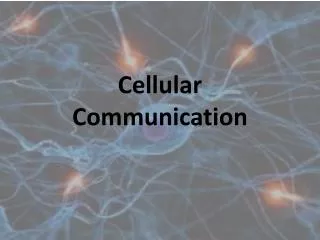
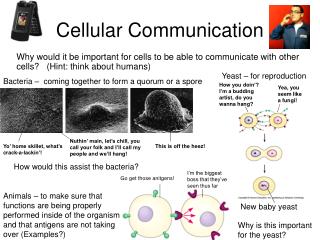
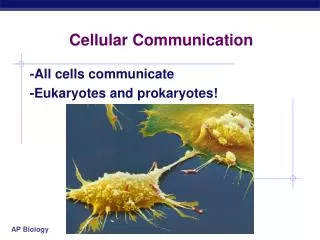
Cellular Communication -All cells communicate -Eukaryotes and prokaryotes!
Communication process usually involves the plasma membrane • 2 types: local and long-distance
Local Signaling • Direct contact • Gap junctions or plasmodesmata • Cytoplasms of cells directly connected • Animal cells also by direct contact between membrane-bound molecules • Use of messenger molecules for short-distance communication • Paracrine signaling • Synaptic signaling
Long-Distance • Use of hormones to travel long distances • Nervous and endocrine system
Reception • Signaling molecule= ligand • Causes a change in the receptor protein • Most receptors are found in the plasma membrane • Ligands are water-soluble
Receptors in the Plasma Membrane • Two Major Types • G protein-coupled receptors (GPCR) • Ligand-gated ion channels
Intracellular Receptors • Cytoplasm or nucleus • Hydrophobic signals- ex. steroids
Transduction by Cascade • Transduction of cell signaling usually involves multiple steps • Gives possibility of signal amplification • Signal transduction pathway usually involves proteins • Change in shape of a protein • Phosphorylation
Protein Changes • Protein kinase- adds phosphate groups from ATP to a protein
Second Messengers • Small, non-protein, water-soluble molecules • Ex. Cyclic AMP or Ca2+ • Easily move through cytoplasm • Activate other proteins • Epinephrine
Cholera and interruption of signaling • Disruption of GPCR