Understanding Polynomials: Definitions, Types, and Graphical Representation
This comprehensive guide explores polynomials in one variable, starting with their definition and structure, highlighting real polynomial equations, and identifying their zeros. It covers types of polynomials based on the number of terms and exponents, and includes detailed graphical representation for linear and quadratic polynomials. The guide also discusses the significance of the discriminant in quadratic equations and the conditions for determining the zeros and signs of polynomials. Enhance your understanding of these fundamental mathematical concepts with clear examples.

Understanding Polynomials: Definitions, Types, and Graphical Representation
E N D
Presentation Transcript
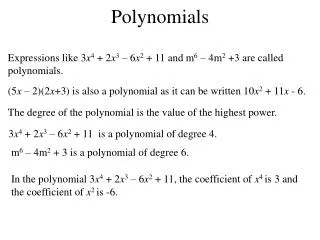
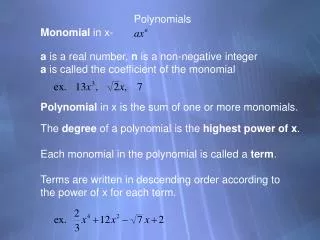
POLYNOMIAL IN ONE VARIABLE • For real variable x, an expression of the type P (x) = a0 + a1x + a2 x2 + ----- + an x n with real co-efficient a0, a1, a2, an and n is positive integer is the real polynomial in one variable.
POLYNOMIAL EQUATIONS • If P (x) is a real polynomial then P (x) = 0 is a polynomial equation. • 2x + 3 is a polynomial and 2x + 3 = 0 is polynomial equation. • 2x -1 + 3 is not a polynomial but 2x -1 + 3 = 0 is still a polynomial equation.
ZERO OF POLYNOMIAL • The value of variable x = a is called the zero of polynomial p (x) if P (a) = 0.
ZERO OF POLYNOMIAL • The zero of an polynomial are the x co-ordinates (Abscissa) of the points where curve y = f (x) crosses the x-axis. e.g. for x + 1 consider y = x + 1 X = -1 is the zero of the polynomial x + 1. 1 X o -1 Y/
ZERO OF POLYNOMIAL • For polynomial x2 -3x + 2 • Consider y = x2 -3x + 2 The zeros of the polynomial are 1 and 2. X o 1 2 Y/
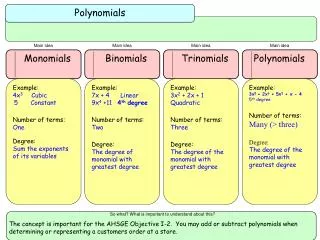
TYPES OF POLYNOMIALS • Polynomials are named based on two criterions 1. number of terms the polynomial has. 2. the highest exponent of the variable present in the polynomial.
GRAPHICAL REPRESENTATION OF LINEAR POLYNOMIAL • For linear polynomial a x + b , a ≠ 0, consider y = a x + b. • Linear polynomial represent a straight line intersecting x-axis at point (-b/a, 0) and y-axis at (0,b) Y For - 2x + 4, curve is a straight line interesting x-axis at (2,0) and y-axis at (0,4) 4 X O 2
QuadraticPolynomial Polynomial in one variable is called quadratic polynomial if a3, a 4 ,------ = 0 , a 2≠ 0 and a 0, a 1 may or may not be zero. In general, a quadratic polynomial is denoted as a x2 + b x + c , with a ≠ 0 X2 –5x +4
GRAPHICAL REPRESENTATION OF QUADRATIC POLYNOMIAL • For quadratic polynomial a x2 + b x + c , a ≠ 0, consider y = a x2 + b x + c.
GRAPHICAL REPRESENTATION OF QUADRATIC POLYNOMIAL • For quadratic polynomial a x2 + b x + c , a ≠ 0, consider y = a x2 + b x + c.
GRAPHICAL REPRESENTATION OF QUADRATIC POLYNOMIAL • For quadratic polynomial a x2 + b x + c , a ≠ 0, consider y = a x2 + b x + c.
GRAPHICAL REPRESENTATION OF QUADRATIC POLYNOMIAL • For quadratic polynomial a x2 + b x + c , a ≠ 0, consider y = a x2 + b x + c.
GRAPHICAL REPRESENTATION OF QUADRATIC POLYNOMIAL • For quadratic polynomial a x2 + b x + c , a ≠ 0, consider y = a x2 + b x + c. Put b2 – 4ac = D
GRAPHICAL REPRESENTATION OF QUADRATIC POLYNOMIAL • For quadratic polynomial a x2 + b x + c , a ≠ 0, consider y = a x2 + b x + c. It is a parabola with vertex at (-b/2a,-D/4a)
GRAPHICAL REPRESENTATION OF QUADRATIC POLYNOMIAL • For quadratic polynomial a x2 + b x + c , a ≠ 0, consider y = a x2 + b x + c. If a > 0 No Zeros
GRAPHICAL REPRESENTATION OF QUADRATIC POLYNOMIAL • For quadratic polynomial a x2 + b x + c , a ≠ 0, consider y = a x2 + b x + c. If a < 0 No Zeros
SIGN OF QUADRATIC POLYNOMIAL FOR THE EXPRESSION F(X) = a x 2 + b x + c, a ≠ 0 CASE I For D = b 2 – 4 ac < 0 If a > 0 then f (x) > 0 for all real values of x. If a < 0 then f (x) < 0 for all real values of x. a < 0, f (x) < 0 a > 0, f (x) > 0
SIGN OF QUADRATIC POLYNOMIAL FOR THE EXPRESSION F(X) = a x 2 + b x + c, a ≠ 0 CASE II For D = b 2 – 4 ac = 0 If a > 0 then f (x) ≥ 0 for all real values of x. If a < 0 then f (x) ≤ 0 for all real values of x. a < 0, f (x) ≤ 0 a > 0, f (x) ≥ 0
SIGN OF QUADRATIC POLYNOMIAL FOR THE EXPRESSION F(X) = a x 2 + b x + c, a ≠ 0 CASE III For D = b 2 – 4 ac > 0 If a > 0 then f (x) ≥ 0 for all real values of x. If a < 0 then f (x) ≤ 0 for all real values of x. a < 0, f (x) ≤ 0 a > 0, f (x) ≥ 0
SIGN OF QUADRATIC POLYNOMIAL FOR THE EXPRESSION F(X) = a x 2 + b x + c, a ≠ 0 CASE III For D = b 2 – 4 ac > 0 If a > 0 then Y > 0 for x < α , x > β f (x) = = 0 for x = α , β < 0 for α < x > β X α β
SIGN OF QUADRATIC POLYNOMIAL FOR THE EXPRESSION F(X) = a x 2 + b x + c, a ≠ 0 CASE III For D = b 2 – 4 ac > 0 If a < 0 then f (x) Y < 0 for x < α , x > β f (x) = = 0 for x = α , β > 0 for α < x > β X α β
CONCLUSION • Polynomial f (x) = a x2 + b x + c has the same sign as that of “a” except when zeros of quadratic polynomial are real and distinct and x lies between them.
Descartes' Rule Of Signs • The maximum number of positive real zeros of a polynomial f (x) is the number of changes of sign from positive to negative and vice versa in f (x). e.g. in case of x3 – 2 x2 – x + 2 [ = ( x - 1) (x - 2) ( x +1)] + - - + Here zeros are 1, 2 & -1 1st 2 nd Positive zeros
The maximum number of negative real zeros of a polynomial f (x) is the number of changes of sign from positive to negative and vice versa in f (- x). e.g. in case of x3 – 2 x2 – x + 2 [ = ( x - 1) (x - 2) ( x +1)] f(- x) = - x3 – 2 x2 + x + 2 Here zeros are 1, 2 & -1 - + + + 1st Negative zeros
POSITIVE OR NEGATIVE ZEROS • X3 +2X2-9X-18 Find positive and negative zeros. • If the remainder on division of x3+2x2+kx+3 by x-3 is 21,find the quotient and the value of k.Hence ,find the zeros of the cubic polynomial x3+2x2+kx-18 Ans (3,-2,-3)
QUESTIONS • Find k so that x2+2x+k is a factor of 2x4+x3-14x2+5x+6.Also find all the zeros of the polynomials.(-3: -3,1,2,-1/2; 1,-3) • Given that the zeros of the cubic polynomial x3-6x2+3x+10 are of the form a,a+b,a+2b for some real numbers a and b,find the values of a and b as well as the zeros of the given polynomials.(-1,2,5)