Exploring Speciation: Concepts, Factors, and Examples of Evolutionary Processes
130 likes | 258 Vues
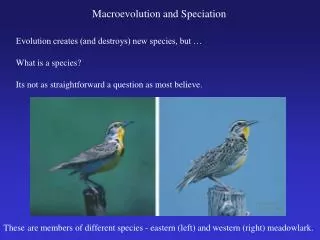
This chapter delves into the modes of speciation, distinguishing between macroevolution and microevolution. It engages students in a jigsaw debate to analyze various species concepts, encouraging them to assess the pros and cons, practical identification methods, and real-world examples of these concepts. The discussion covers reproductive isolation barriers, allopatric and sympatric speciation, and different tempos of speciation like punctuated equilibrium and gradualism. Concluding with Darwin's insights, it emphasizes the grandeur of evolutionary processes and the factors influencing speciation.


Exploring Speciation: Concepts, Factors, and Examples of Evolutionary Processes
E N D
Presentation Transcript
Evolution!Concept 1: Analyzing the modes of speciation (macroevolution) Chapter 24 (The Origin of Species) P. 159-160 in Holtzclaw
What is a ‘Species’? Jigsaw Debate • On your own: • Determine the pros and cons of your particular species concept. Do you agree? What are some examples in nature? Is this a practical means of identifying species? • Meet with those that have the same concept as you: • Compare notes. Get argument ready. • Get together with those with the same number: • Share and solidify the pros and cons, examples, and practicality of each species concept. • Determine which species concepts your group agrees with most. - Which is the most practical?- Which explains the origin of species best? • Share with class!
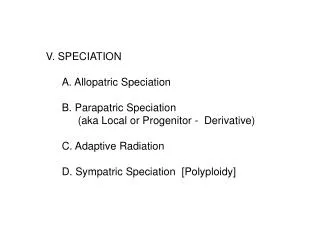
Concept 1 - Speciation • The difference between microevolution and macroevolution • The biological concept of species • Prezygoticand postzygotic barriers that maintain reproductive isolation in natural populations • How allopatricand sympatric speciation are similar and different • How an autopolyploid or an allopolyploid chromosomal change can lead to sympatric speciation • How punctuated equilibrium and gradualism describe two different tempos of speciation
The Origin of Species– Charles Darwin • On the last page… • “Thus, from the war of nature, from famine and death, the most exalted object which we are capable of conceiving, namely, the production of the higher animals, directly follows. There is grandeur in this view of life, with its several powers, having been originally breathed by the Creator into a few forms or into one; and that whilst this planet has gone cycling on according to the fixed law of gravity, from so simple a beginning endless forms most beautiful and most wonderful have been, and are being evolved.”
Now… • Activity 24.1 – What factors affect speciation? • Case Study!