1 / 8

I. DNA Replication

This overview delves into the essential processes of DNA replication, including the role of hydrogen bonds and DNA polymerase in pairing free nucleotides with complementary bases to produce identical strands of DNA. Additionally, it explores the various types of mutations: point mutations, frameshift mutations, and chromosomal mutations (deletion, inversion, and translocation). The concept of non-disjunction and its implications, such as Trisomy 21 (Down's Syndrome), are also examined. These genetic alterations can significantly impact both cellular function and organism development.

Télécharger la présentation

I. DNA Replication

An Image/Link below is provided (as is) to download presentation Download Policy: Content on the Website is provided to you AS IS for your information and personal use and may not be sold / licensed / shared on other websites without getting consent from its author. Content is provided to you AS IS for your information and personal use only. Download presentation by click this link. While downloading, if for some reason you are not able to download a presentation, the publisher may have deleted the file from their server. During download, if you can't get a presentation, the file might be deleted by the publisher.

E N D

Presentation Transcript


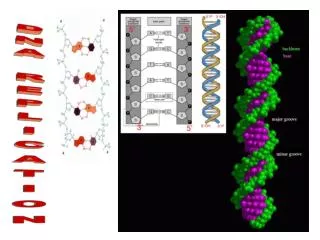
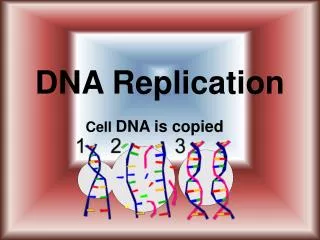
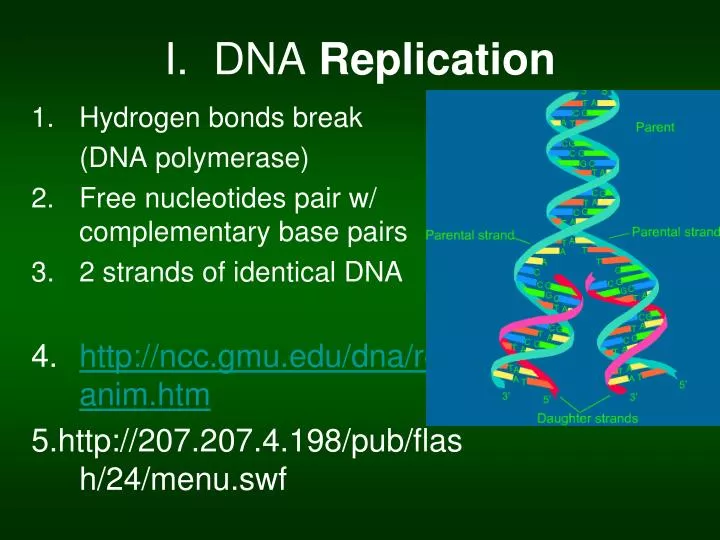
  1. I. DNA Replication Hydrogen bonds break (DNA polymerase) Free nucleotides pair w/ complementary base pairs 2 strands of identical DNA http://ncc.gmu.edu/dna/repanim.htm 5.http://207.207.4.198/pub/flash/24/menu.swf

  2. II. Mutations • A change in the genetic code • Mutagen: substance that causes a mutation • 3 Types: • DNA • Chromosome • Non-DisJunction

  3. 1. DNA Mutation A. Point Mutation: change in a single base pair THE DOG BIT THE CAT THE DOG BIT THE CAR

  4. B. Frameshift Mutation: 1. Single base is added or deleted 2. All other bases shift one spot THE DOG BIT THE CAT THE DGB ITT HEC AT? or THE DOR GBI TTH ECA

  5. 2. Chromosome Mutations: a. Change in the chromosome b. Chromosome: 5 – 10 % DNA 90 – 95% protein

  6. c. 3 types: 1. Deletion: portion missing 2. Inversion: portion inverted on chromosome 3. Translocation: portion moves to the other homologous chrom.

  7. 3.Non-Disjunction: a. Failure of chrom to separate properly during meiosis b. Incorrect number of chrom in egg/sperm c. Examples: Trisomy 21 (Down’s Syndrome)

  8. http://images.google.com/images?gbv=2&hl=en&q=non-disjunction+mutationhttp://images.google.com/images?gbv=2&hl=en&q=non-disjunction+mutation
More Related